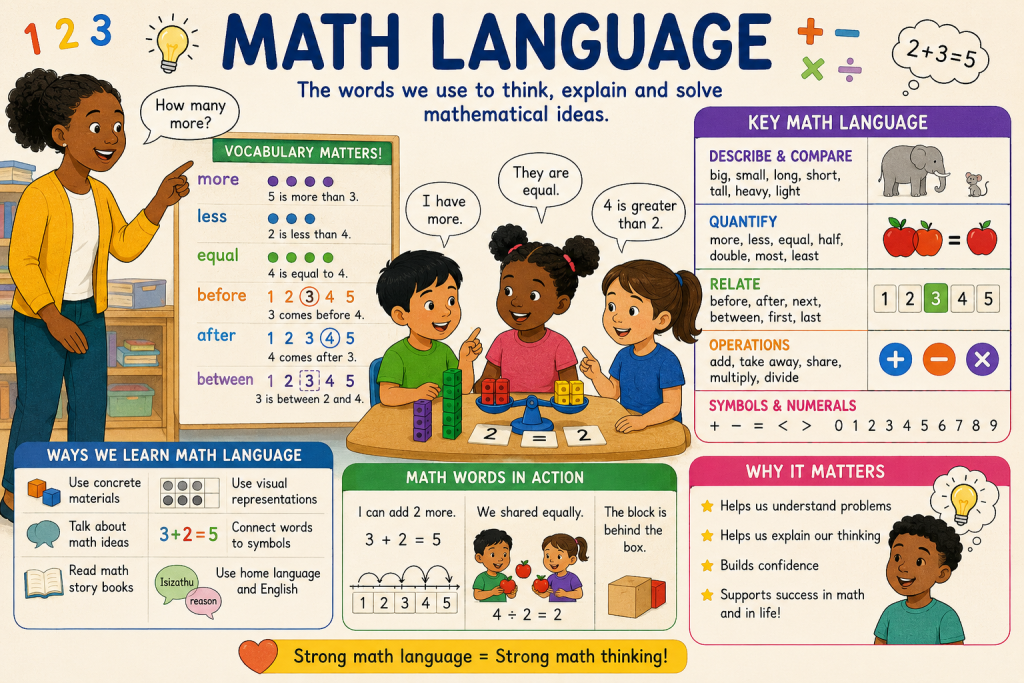
Mathematical language helps learners understand and explain mathematical ideas.
Early teaching of vocabulary and symbols improves problem-solving skills.
Visuals, manipulatives, discussion, and storybooks support language development.
Multilingual support promotes inclusion and understanding.
Teachers play a key role in developing confident mathematical communicators.
Language is the bridge between mathematical ideas and understanding
Teaching the language of mathematics at the foundational level
Mathematical language is central to early mathematical understanding. Foundational mathematical learning is built not only on developing number sense, but also on acquiring the language that enables mathematical thinking. Mathematical language refers to the words, phrases, symbols, and sentence structures used to express mathematical ideas.
Learning to think mathematically is closely linked to learning how to communicate mathematically. When mathematical language is taught in a clear and systematic way, it helps learners make sense of the world around them and develop confidence in their problem-solving abilities (Clements & Sarama, 2014; Van de Walle, Karp, & Bay-Williams, 2018). This section outlines effective approaches to teaching mathematical language in the early years, alongside common challenges and instructional strategies.
Getting to know mathematical language
Mathematical language extends beyond basic vocabulary. It includes descriptive and comparative words such as big/small, long/short, more/less, equal, half, and double, as well as relational terms such as before, after, next, and between. Read more: Maths Vocabulary. It also includes operational language such as add, subtract, share, and multiply, along with symbols such as +, −, =, <, and >.
Baroody (2003) emphasises that the development of mathematical language plays a key role in bridging the gap between informal, intuitive understanding and formal mathematical reasoning. Learners who do not have access to this language may struggle to explain their thinking or follow instructions, even when they understand the underlying concepts.
Developing mathematical language therefore provides learners with the linguistic tools needed to engage more deeply with mathematical ideas. For example, the concept of “equal” supports understanding of balance, fairness, and equivalence in number operations (Charlesworth, 2016). Learners who can use mathematical language effectively are also better able to reason, justify their thinking, and explain solutions (Chapin, O’Connor, & Anderson, 2009). Mathematical language enables learners to describe ideas, ask questions, and support their reasoning, all of which are essential for mathematical fluency (National Council of Teachers of Mathematics [NCTM], 2014).
In multilingual classrooms, mathematical language instruction can further support inclusion by linking new mathematical terms to learners’ home languages and existing linguistic knowledge (Setati, 2008).
Approaches to teaching mathematical language
Young learners benefit from interacting with concrete materials such as counters, shapes, measuring tools, and number lines. Visual representations help make abstract mathematical ideas more accessible by linking them to tangible experiences (Clements & Sarama, 2014).
Teachers should explicitly introduce and model mathematical vocabulary during everyday classroom routines and learning activities. Repetition and exposure to new terms across varied contexts support retention and understanding (Van de Walle et al., 2018). Learners also need opportunities to actively use mathematical language in meaningful contexts in order to internalise new concepts.
Instructional strategies such as “turn and talk”, “think–pair–share”, and sentence stems for mathematical explanation can support the development of academic language (Chapin et al., 2009). Storybooks with mathematical themes can also support vocabulary development and engagement. For example, The Very Hungry Caterpillar(Carle, 1969) can be used to support counting, sequencing, and number-related language in meaningful contexts.
Teachers should explicitly connect mathematical vocabulary with symbolic representations. For example, when introducing addition, linking the word “more” with the plus sign (+) helps learners connect language to symbols (Charlesworth, 2016). Where appropriate, teachers should also draw on learners’ home languages alongside the language of instruction to support understanding and inclusion (Setati, 2008).
Difficulties in teaching mathematical language
Teaching mathematical language presents several challenges. First, learners who speak a different language at home may take longer to understand mathematics terms (Schleppegrell, 2007). In some cases, home languages may not contain direct equivalents for certain mathematical concepts, requiring careful explanation and scaffolding by the teacher. Another challenge is that young learners often rely on everyday language (e.g., “take away”) rather than formal mathematical terms (e.g., “subtract”). Teachers therefore need to deliberately bridge informal and formal language use. In some contexts, limited resources may also constrain instruction, particularly where visual aids, manipulatives, or multilingual materials are not readily available. Addressing these challenges requires careful planning, targeted support, and collaboration with families and language specialists.
To sum up, it is critical to teach mathematical language at the foundational level in order to help children excel in arithmetic in the early stages. This requires a planned, age-appropriate approach that includes teaching terminology, learning by doing, and opportunities to use rich mathematical language. When learners are supported to understand and use mathematical language confidently, they not only improve their mathematical performance but also develop stronger reasoning and communication skills. This enables them to connect mathematical ideas to real-world experiences. Prioritising mathematical language in early education contributes to more inclusive, engaging classrooms and lays a strong foundation for future learning success.
Baroody, A. J. (2003). The development of adaptive expertise and flexibility: The integration of conceptual and procedural knowledge. The Development of Arithmetic Concepts and Skills, 1–33.
Charlesworth, R. (2016). Math and science for young children (8th ed.). Boston, MA: Cengage Learning.
Chapin, S. H., O’Connor, C., & Anderson, N. C. (2009). Classroom discussions in math: A teacher’s guide for using talk moves to support the common core and more (2nd ed.). Sausalito, CA: Math Solutions.
Clements, D. H., & Sarama, J. (2014). Learning and teaching early math: The learning trajectories approach (2nd ed.). New York, NY: Routledge.
Ginsburg, H. P., Lee, J. S., & Boyd, J. S. (2008). Mathematics education for young children: What it is and how to promote it. Washington, DC: National Association for the Education of Young Children (NAEYC).
National Council of Teachers of Mathematics (NCTM). (2014). Principles to actions: Ensuring mathematical success for all. Reston, VA: NCTM.
Schleppegrell, M. J. (2007). The linguistic challenges of mathematics teaching and learning: A research review. Reading & Writing Quarterly, 23(2), 139–159.
Setati, M. (2008). Access to mathematics versus access to the language of power: The struggle in multilingual mathematics classrooms. South African Journal of Education, 28(1), 103–116.
Van de Walle, J. A., Karp, K. S., & Bay-Williams, J. M. (2018). Elementary and middle school mathematics: Teaching developmentally (10th ed.). Boston, MA: Pearson.