
It is very important to understand what play means before digging into its details. This gives you an immediate picture that will guide you throughout your reading. Play has been defined differently by a number of scholars depending on different factors and situations. This shows how difficult it is to have a common and general cross-cutting definition of play. The current document will try to harmonize and come up with some sort of common definition. According to Garvey (1990), play is a set of voluntary, intrinsically motivated activities related to recreation and enjoyment. Also, Gray (2017) indicates play as self-chosen and self-directed learning, promoting activities guided by mental rules preferred by children. Play encompasses both culturally framed and unframed activities that are subsumed under the umbrella of playfulness (Roopnarine, 2011). Therefore, it can be concluded that play is a series of well-organized fun activities used by teachers to motivate learners and facilitate the transfer of knowledge as well as develop important skills in their learners while refreshing their minds. Play catalyzes and scaffolds children’s learning in a simple and natural setting.
Play can be categorized into various types based on the nature of the activity, cognitive process, and emotional engagement (e.g., Gordon & Browne, 2017). Play types based on activity nature include physical and constructive play, exploratory play for cognitive processes, and dramatic play for emotional engagement (Piek et al., 2008; Hirsh-Pasek et al., 2009; Fisher et al., 2011; Singer & Singer, 2005; Gray, 2017). We can also categorize play based on the players’ relative power and control. This can be either free or ‘pure’ play, whereby children have all the control and adults are passive observers; guided play; teacher-child collaboration, with the child’s interests foregrounded (Hargraves, 2019). Therefore, the main types of play in this text are explained hereunder as follows:
Physical or locomotor play is a type of play that engages children in activities that involve some forms of body exercises, such as playing football, running, jumping, and acrobatics. Likewise, locomotor play involves body movements and object manipulation that enhance motor skills such as running, hopping, galloping, throwing, and catching (Alhassan et al., 2012). Physical play increases the strength, speed, agility, and balance of body muscles (Sutapa et al., 2021). Thus, physical play contributes to children’s physical, social, emotional, and cognitive development.
Constructive play is a structured and goal-oriented activity where children use play materials to create or build something (Johnson et al., 2005). Constructive play involves building structures like roads, castles, clay balls, spaceships, and puzzles using various materials and tools (Drew et al., 2008). Constructive play helps develop problem-solving skills, understand spatial relationships, as well as critical and creative thinking among children in early childhood education.
Dramatic play involves children learning to express themselves, understand different perspectives, and build crucial social skills like cooperation, sharing, and problem-solving. Dramatic play fosters social, emotional, and language development by allowing children to interact with peers in various pretend scenarios, enhancing their vocabulary and communication skills (Goldstein & Lerner, 2018; Broadhead & Chesworth, 2015). It also allows children to explore different social roles and practice empathy by stepping into the shoes of others.
Exploratory play is a method where children engage with toys and everyday objects to learn how to create and manipulate things (Brothers of Charity, 2017). Exploratory play provides children with numerous opportunities to acquire extensive knowledge about learning (Gweon et al., 2014). Children utilize physical skills and sensations to comprehend materials, their properties, and their functions (Brothers of Charity, 2017). When children investigate their surroundings, they develop a sense of curiosity, which leads to deeper learning and an understanding of cause and effect.
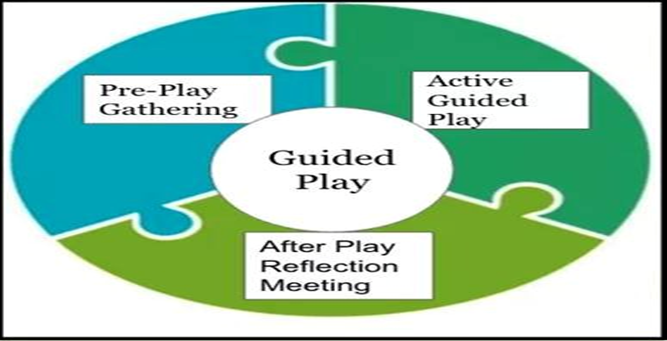
Play can also be conceptualised through the roles that participants take within play. Guided play involves teachers intentionally supporting and extending children’s play to promote specific learning goals. See the diagram below.
Teacher-directed play is structured and led by the teacher/educator with clear objectives and rules while free play allows children to choose activities, materials, and play partners independently, fostering creativity and self-expression.
According to Fleer (2021), the following are the characteristics of play in preschool and school:
Developing play for early childhood involves a variety of prerequisites and requires consideration of children’s developmental stages and interests of the children (Nodelman & Reimer, 2003; Hirsh-Pasek & Golinkoff, 2003). The following are the prerequisites for effective design and development of play:
Play is an important part of any early childhood program, and the benefits of play include both physical, emotional, and cognitive development for early learners.
Parker and Thomsen (2019) found that incorporating playful pedagogies into early childhood education classes is the most effective method for enhancing learning outcomes. Scholars have referred to different pedagogies for integrating play, including ‘learning through play’ (Parker et al., 2022), ‘play-based learning’ (Barblett, 2010), ‘playful learning’ (Fisher et al., 2010), and ‘purposeful play’ (AlleeHerndon & Roberts, 2020). Play can also be integrated into ECEC through learning activities that develop specific competencies such as body movement, gross- and fine- motor skills, and the creation of sports materials. Play activities can be integrated into curriculum content, such as arts and sports in Tanzania’s ECEC curriculum, which incorporates various plays.
Alhassan, S., Nwaokelemeh, O., Ghazarian, M., Roberts, J., Mendoza, A. & Shitole, S. (2012). Effects of locomotor Skill program on minority preschoolers’ physical activity levels. Paediatric Exercise Science, 24, 435-449. Human Kinetics, Inc.
Broadhead P and Chesworth L (2015) Friendship culture and playful learning. In: Moyles J (ed) The Excellence of Play. Maidenhead: Open University Press, pp. 94–105.
Brothers of Charity. (2017). Autism Services South Lee: Information Sheet – Exploratory Play.
Drew, W. F., Christie, J., Johnson, J.E, Alice M. Meckley, A.M. & Nell, M.L. (2008). Constructive play: A value-added strategy for meeting early learning standards. Young Children, 38-44.
Fisher, A., Boyle, J.M.E., Paton, J.Y., Tomporowski, P., Watson, C., MacColl, J.H. & Reiliy, J. (2011). Effects of a physical education intervention on cognitive function in young children: randomized controlled pilot study. BMC Pediatrics 11 (97).
Fleer, M. (2021). Play in the Early Years. 3rd Edition. Cambridge University Press. ISBN: 9781108821148.
Gander, Mary J. and Harry W. Gardiner (1981). Child and adolescent development. Boston: Little, Brown and Company.
Goldstein, T. R., & Lerner, M. D. (2018). Dramatic pretend play games uniquely improve emotional control in young children. Developmental Science, 21(4), e12603.
Gordon, A. M., & Browne, K. W. (2017). Beginnings & beyond. Foundations in early childhood education.
Gweon H., Pelton H., Konopka J. A., Schulz L. E. (2014). Sins of omission: children selectively explore when teachers are under-informative. Cognition 132, 335–341. 10.1016/j.cognition.2014.04.013
Hargraves, V. (2019). What is play and why is it important for learning? The Education Hub 2019.
Hirsh-Pasek, K., Golinkoff, R. M., Berk, L. E., & Singer, D. G. (2009). A mandate for playful learning in school: Presenting the evidence. Oxford University Press.
Hughes, Fergus P. (2009). Children, Play and Development. SAGE publishers.
Johnson, J., J. Christie, & F. Wardle. 2005. Play, development, and early education. Allyn & Bacon.
Piek, J. P., Bradbury, G. S., Elsley, S. C. & Tate, L. (2008). Motor coordination and social-emotional behaviour in preschool-aged children. International Journal of Disability, Development and Education, 55 (2), 143–151.
Santrock, J. W. (2007). Parten’s classic study of play. A topical approach to life-span development (3rd ed.). New York: McGraw-Hill.
Singer, D. G., & Singer, J. L. (2005). Imagination and play in the electronic age. Cambridge, Harvard University Press.
Sutapa, P., Pratama, K.W., Rosly, M.M., Ali, S.K.S, & Karakauki, M. (2021). Improving motor skills in early childhood through goal-oriented play activity. Children, 8(11):994.
Tomlin, Carolyn Ross (2020). Play: A historical review. Early Childhood News.