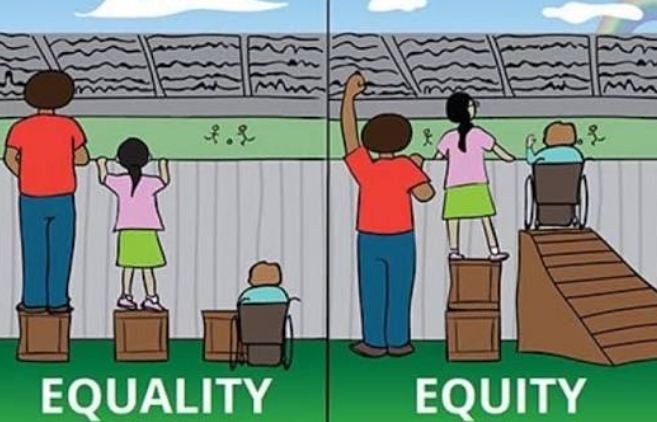
The most well-known image used in education shows three people of different heights trying to watch a game over a fence:
Equality — Each person is given a box of the same size to stand on to see over the fence. The tallest person can see fine, but the shortest still cannot see over the fence.
Equity — Each person is given the number of boxes needed to see over the fence based on their need. Now everyone can see over the fence equally well.
This image is widely used by equity-minded educators to communicate that providing the same support to every student isn’t the goal — instead, each individual should receive support that meets their specific needs.
(This image is free to use with attribution: “Interaction Institute for Social Change | Artist: Angus Maguire.”)
Key Elements of the Illustration:
The Fence: Represents structural barriers and systemic, unequal, or exclusionary circumstances.
The Boxes (Equality): Everyone gets the same support, but the shortest person still cannot see, signifying that equal treatment does not guarantee equal outcomes.
The Adjustment (Equity): Resources (boxes) are allocated based on individual needs (e.g., the shortest person gets two boxes, the tallest gets none) so everyone can see. In some illustrations the adjustment is depicted with a ramp constructed for a wheelchair.
The Ground (Reality): In some versions, the ground is sloped, showing that people start from different, unequal positions.