
Strong foundational skills in mathematical problem solving, which are developed in early childhood, are critical not only for success in the fields of science, technology, engineering and mathematics but also for everyday quantitative reasoning. The acquisition of mathematical skills relies on the protracted interactive specialization of functional brain networks across development.
Knowledge from neuroscience (study of the nervous system) about how the brain learns can help educators make better and more informed pedagogical choices, plan lessons and make effective real-time decisions in the classroom.
Current theories of brain development emphasize the role of learning, experience and education in shaping brain function and structure. For example, Clements (2001) provided the following key messages that link neuroscience to early childhood maths education:
As described here, Elgavi and Hamo (2024) summarized some important concepts from neuroscience that are important for understanding maths-specific networks and development in early childhood. These concepts help us to determine the most important findings from neuroscientific research on brain development, structure and function.
Like reading ability, mathematical abilities are not located in a single brain area. They engage multiple regions of the brain and are dependent on the functioning of and communication between individual brain areas. The emergence of regional functional specialization and fine-tuning of neuronal response properties are influenced by interactions and communications with other brain regions.
Some of the most important brain regions involved in mathematical thinking are described in Figure 1. Together, these different areas form the functional system of mathematical skills. Many of these regions are not maths-specific and are involved in other abilities. Some regions are more specialized for mathematics than others. Mathematical understanding develops through the interaction of all these areas and abilities; the neural connections between these areas develop in early childhood when neural plasticity is high.
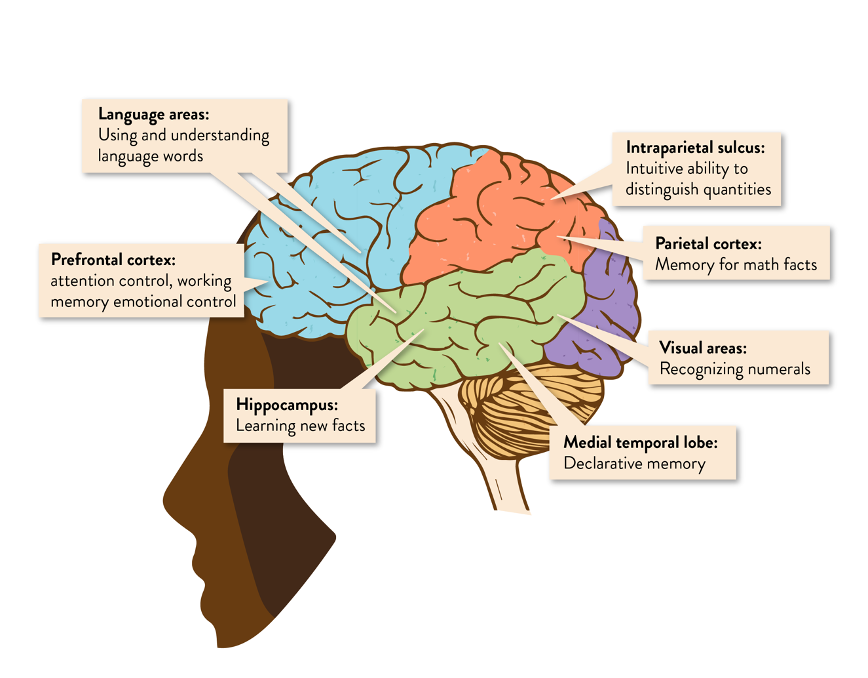
Figure 1. Brain regions involved in mathematical processes. The labels show approximate locations. Notice that the hippocampus is located inside the brain.
Mathematical abilities involve various brain regions, and the connections between these areas develop throughout childhood, particularly during early childhood when brain plasticity (the ability of neural networks in the brain to change through growth and reorganization) is high. Therefore, it is crucial to engage young children in rich mathematical activities, activating and connecting the different cortical networks involved in mathematics.
Human infants have an innate sense of quantity. This ability is proposed to rely on two separate neural systems for numerosity discrimination: a precise system for the representation of small quantities (1–3) and an approximate system for the representation of large quantities (≥ 4). The object tracking system is responsible for keeping track of small numbers of individual objects. It allows infants to recognize and remember specific items and thus differentiate sets with small numbers of items (for example, ** vs ***) or detect changes (for example, a change from * to ***). This system is more precise but limited to small quantities. The approximate number system (ANS), on the other hand, is used for estimating and comparing larger quantities. It helps infants detect that a group of 14 objects is different from a group of 6 objects, even if they cannot count them exactly. This system is less precise but can handle large quantities.
The ability to distinguish quantities early on is thought to lay the foundation for learning symbolic numerical skills. Some longitudinal studies have examined the predictive value of infants’ number discrimination ability on later mathematical skills. Performance on a number discrimination task with large numbers in infancy (at 6 months old) significantly predicted early number skills at 3.5 years of age, including skills like number concept, counting and number comparison and basic calculation (Starr et al. (2013)). Ceulemans et al.’s (2015) study with small quantities did not reveal a significant relationship between number discrimination in infancy (8 months) and number concept knowledge at 4 years of age. However, a predictive value of toddlers’ number discrimination (24 months) for number concept knowledge at 4 years of age was found.
Development of the ANS is related to later maths abilities. The ANS focuses on the approximate grasp of quantities and may be improved, particularly through games involving estimation and comparison that discourage or even preclude direct counting, and encourage using multiple senses.
Neurocognitive research shows the importance of the connections between three different number representations, each involving different brain areas (Dehaene (1997)) (Fig. 2).
The intraparietal sulcus (IPS) is involved in the intuitive understanding of quantity representation (concrete quantities and magnitudes), or analog magnitude representation. This code is used for estimating and comparing quantities. It is often mentally visualized as a number line on which numbers are represented as points along a continuum. This representation is crucial for tasks involving approximate calculations and number sense. Visual areas are crucial for processing written number symbols (e.g. 1, 2, 3). It is used for tasks that require reading and writing numbers, such as arithmetic operations. Language areas, in turn, are crucial for processing written and spoken number words (e.g. five, eight). They are essential for tasks involving verbal counting, number recall and arithmetic fact retrieval.
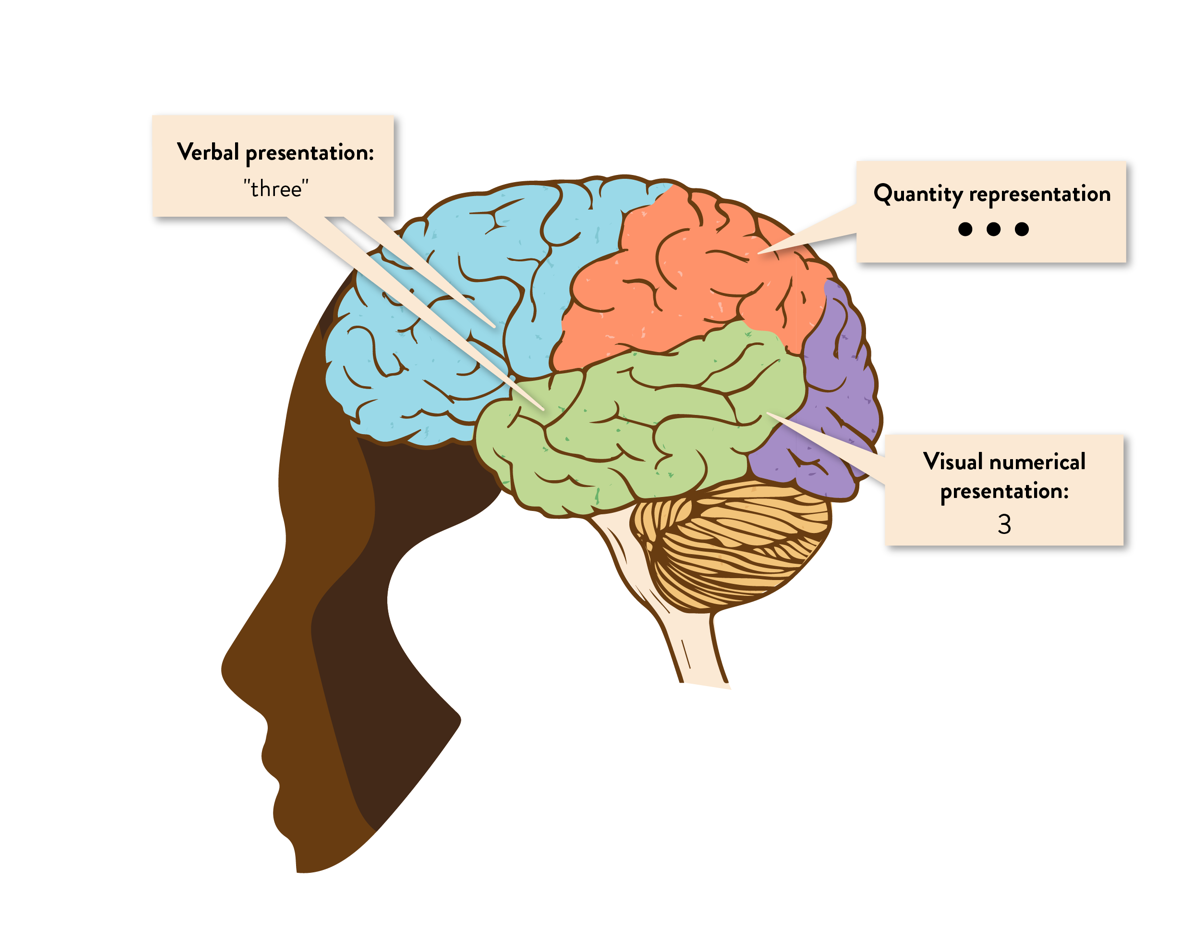
Figure 2. The triple code model. The arrows show the approximate locations in the brain.
These three representations interact and are connected through neural pathways, allowing for flexible and efficient numerical processing. The ability to understand mathematics depends on these three brain systems and their connections.
For example, in the context of arithmetic, most people can readily answer ‘two plus three equals five’ or ‘nine times four is thirty-six’ from memory, after having encountered these facts many times through rote learning. In other words, there is no need for one to actually understand the meaning of the numbers. In the triple code model, it is assumed that retrieval from memory mainly occurs for well-known and learned mathematical facts, such as multiplication tables or simple addition problems. On the other hand, someone might be able to approximate that 6 times 6 is less than 50 without being able to retrieve this answer precisely from memory. In this case, their solution relies on the use of the analog magnitude representation of quantities.
Retrieval of facts from memory alone is obviously not enough for mathematical understanding. For example, many young children know how to repeat numbers as a learned sequence (e.g. ‘one, two, three…’), but this does not mean that they know how to associate quantities with those words. Likewise, at a later age, children can learn multiplication equations by rote (e.g. ‘two times three is six’) without necessarily understanding what they mean.
On the other hand, children who never learn any maths facts by rote but rely only on intuitive and concrete understanding will likely run into trouble. The best way to understand the importance of rote knowledge is by considering slightly more advanced arithmetic questions, such as those introduced in primary school. For example, it is difficult to solve questions such as ‘nine times six plus seven’ without knowing the answer to ‘nine times six’ by rote; this is because working memory, or the ability to remember and manipulate small amounts of information for short periods of time, is severely limited. Calculating the answer without knowing any maths facts (rote maths knowledge) easily overloads one’s working memory, leading to mistakes in multiplication or forgetting to add the seven at the end.
Number games and accessories in early childhood should include all three components of numerical representation (quantities, numerals and number words) and involve encounters with simple maths facts (e.g. ‘two plus three equals five’) in different contexts.
There is evidence that the strength and efficiency of the connections between the three numerical representations predict mathematical abilities and neural connections between the three brain networks involved in understanding numerical information can be strengthened through practice.
The triple code model indicates the understanding of numerical information is dependent on the neuronal connections between three systems: the concrete system, verbal number word system and visual symbolic number system. It’s crucial to develop and strengthen these connections, especially in early childhood, when the brain is developing and creating the foundational networks that will serve us later in life.
Ceulemans, A., Titeca, D., Loeys, T., Hoppenbrouwers, K., Rousseau, S., & Desoete, A. (2015). The sense of small number discrimination: The predictive value in infancy and toddlerhood for numerical competencies in kindergarten. Learning and individual differences, 39, 150-157.
Clements, D. (2001). Mathematics in the preschool. Teaching Children Mathematics, 7(5), 270–275.
Dehaene, S. (1997): The Number Sense: How the Mind Creates Mathematics. New York: Oxford University Press.
Elgavi, O., & Hamo, P. (2024). Math on the Brain: Seven Principles from Neuroscience for Early Childhood Educators. Early Childhood Education Journal, 1-12.
Starr, A., Libertus, M.E., & Brannon, E.M. (2013b). Number sense in infancy predicts mathematical abilities in childhood. Proceedings of the National Academy of Sciences of the United States of America (PNAS), 110, 18116–18120. http://dx.doi.org/10.1073/pnas.1302751110.
Tokuhama-Espinosa, T. (2015). One way neuroscience can improve Pre-literacy and Pre-numeracy skills in Young Children. World Education Research Association: International perspectives on language, literacy and learning. Corvinus University.