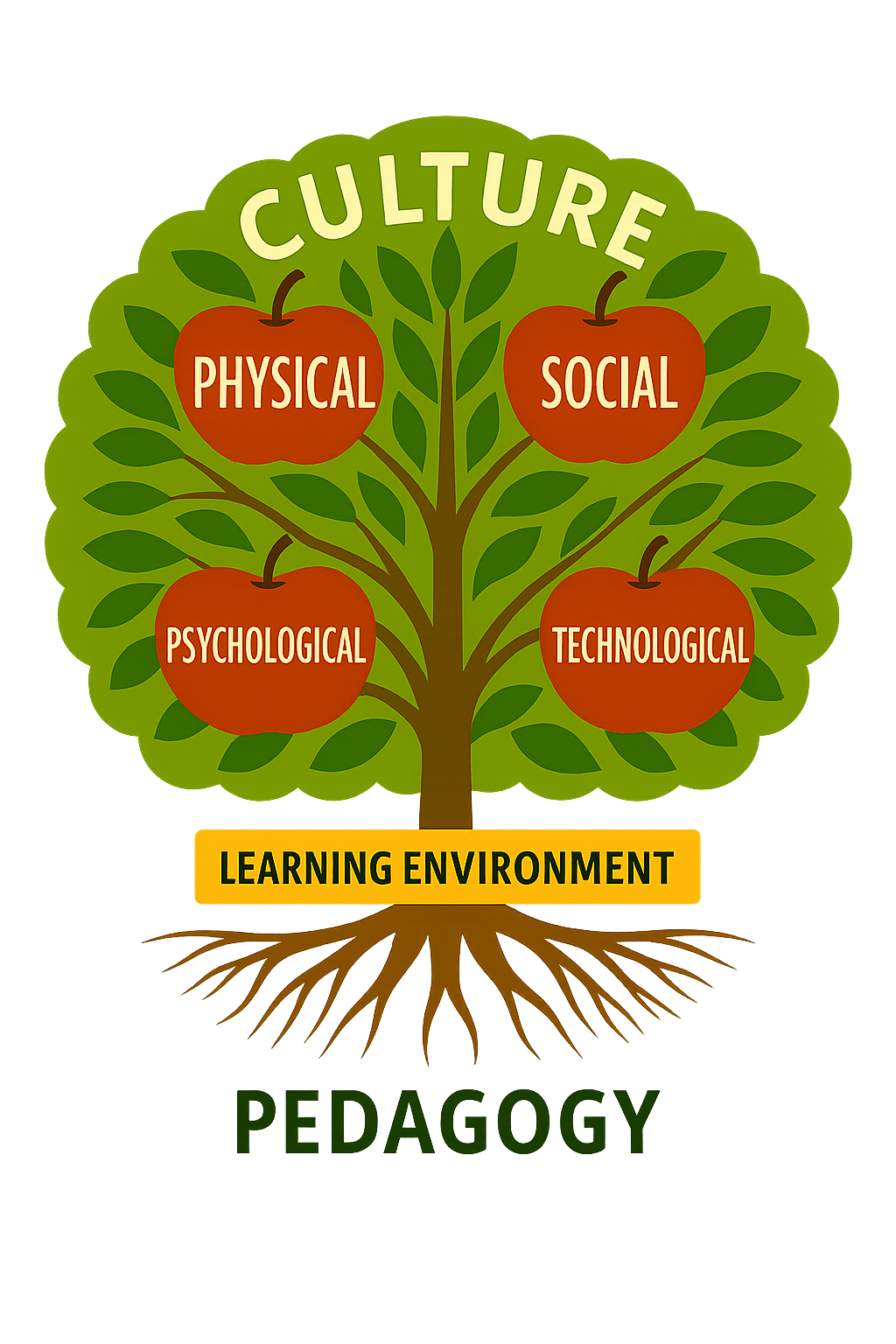
Learning environments in ECE are crucial for young children’s holistic development. Learning environments are multidimensional and dynamic systems that are shaped by physical, social, psychological, and technological dimensions, as well as culture as an overarching and embracing dimension. These dimensions are formed in interaction with each other and can be shaped and reshaped by early childhood pedagogy. Dimensions of the learning environment play a role in fostering holistic, inclusive, and equitable development in early childhood. Furthermore, they play a critical role in promoting inclusion and equity: access to appropriate spaces, supportive relationships, and meaningful resources ensures that all children can participate fully and receive the support they need.
Introduction
In the context of early childhood education, learning environments play a central role in shaping children’s experiences, participation, and developmental outcomes. Learning environments are not limited to physical surroundings; they are currently understood as multidimensional ecosystems consisting of physical, social, psychological, technological, and cultural dimensions (e.g., Majoinen, 2019; Manninen et al., 2007) that are formed in interaction with each other and can be shaped and reshaped by early childhood pedagogy (see Figure 1 below).
Importantly, these dimensions do not function in isolation. They are influenced by institutional culture, leadership, and pedagogical practices, all of which affect how learning, interaction, and support measures are implemented in everyday educational settings (Majoinen, 2019). From a systemic perspective, learning environments are continuously constructed through interactions between children, educators, spaces, and structures. Recent research has further expanded this understanding by examining how innovative spatial solutions can transform both physical and social environments and, in turn, influence pedagogical practices (Lilleberg & Raittila, 2026).
At the level of the child in ECEC, the main purpose of the learning environment is to allow children to benefit from teaching and learning opportunities while fostering their participation in a community of learners.
Figure 1: Dimensions of the learning environment
The Physical Learning Environment
Definition and Characteristics
The physical environment is typically one of the most intuitive dimensions that comes to mind when considering the learning environment. Physical learning environment includes spatial arrangements, furnishings, materials, sensory qualities (e.g., humidity and temperature; see Tamblyn et al., 2023), and both indoor and outdoor areas that shape children’s opportunities for exploration and learning (Manninen et al., 2007). A well-designed environment is safe, accessible, flexible, and aesthetically coherent. Recent developments in ECE architecture emphasise flexible spatial solutions. One example is the homebase model, in which learning environments within ECEC settings consist of interconnected spaces that can be adapted for different group sizes and activities (Lilleberg & Raittila, 2026). These environments often include smaller rooms, shared open areas, and clearly defined functional zones that support varied pedagogical approaches.
The physical environment is sometimes described as the “third teacher” (Strong-Wilson & Ellis, 2007), highlighting its active role in shaping children’s behaviour, agency, and learning. Spatial design influences children’s autonomy by enabling independent movement and access to materials while also supporting physical development through opportunities for active play and exploration. In addition, the environment shapes sensory experiences (see Tamblyn et al., 2023), which are essential for young children’s learning, and provides diverse opportunities for different forms of play, including imaginative, constructive, and social play. For example, accessible materials and child-sized furniture promote self-directed activity, while clearly organised spaces support concentration and reduce cognitive overload. Flexible environments also enable educators to implement dynamic grouping, small-group work, and context-sensitive pedagogy, thereby enabling more individualised instruction and responsive teaching practices (Lilleberg & Raittila, 2026).
The Role of the Physical Learning Environment in Early Childhood Education in Africa
In early childhood, learning is embodied, sensory, and play-based. The physical environment is directly linked to motor and sensory development by providing opportunities for movement and interaction with materials. It also influences emotional regulation, as calm and well-structured spaces can support children’s ability to focus and manage their emotions. Furthermore, the environment shapes children’s engagement and willingness to explore. Research has also shown that the availability of appropriate physical spaces is essential for implementing support measures. For instance, the absence of quiet rooms or small-group areas can hinder individualised support and inclusion (Majoinen, 2019). Thus, the physical environment is not merely a backdrop to learning but a central component of pedagogical practice.
In the African context, many Early Childhood Development and Education (ECDE) centres in Kenya suffer from shortages of teaching and learning materials, including insufficient classrooms, furniture, and play resources. This scarcity hampers the effective implementation of the ECEC curriculum and affects children’s learning experiences (Kenpro, 2014). Similarly, many ECE centres in Namibia face shortages of teaching and learning materials, inadequate infrastructure, and limited qualified staff. For example, a report noted a shortage of childhood development centres across the country, stating that only one in five children aged three and older attend ECD centres due to insufficient facilities and funds. The Capricorn Foundation in Namibia has sought to address this gap by investing in the printing of pre-primary workbooks and the provision of teaching materials to both urban and rural communities, highlighting the continuing challenges related to educational resources and infrastructure.
The Social Learning Environment
Definition and Characteristics
The social learning environment consists of interpersonal relationships, group dynamics, communication practices, and cultural norms within the educational community (Manninen et al., 2007). It includes children, educators, families, and increasingly, multidisciplinary teams. This dimension is strongly shaped by pedagogical decisions and institutional culture.
The social learning environment is characterised by warm and responsive educator–child interactions. When educators respond sensitively to children’s needs, listen to their ideas, and include them in shared activities, children develop trust and emotional security. This sense of security allows them to engage more confidently with others and with learning. The social learning environment also includes positive peer relationships. Opportunities for cooperative play, shared experiences, and communication help children form friendships and develop a sense of connectedness. Through these interactions, children learn social norms, empathy, and ways of participating in a community.
Inclusive and participatory practices within the social learning environmentensure that all children have opportunities to engage meaningfully in activities, while shared meaning-making through play and communication supports language development and cognitive growth. When children are given meaningful opportunities to contribute, regardless of their abilities, backgrounds, or language skills, they are more likely to develop a sense of agency and belonging. Practices such as small-group activities, collaborative decision-making, and culturally responsive pedagogy strengthen these experiences.
Importantly, the social environment is also structurally mediated. Majoinen (2019) emphasises that collaboration among educators, leaders, and other professionals is essential for coherent pedagogical practice and effective support systems. Research has also begun to suggest that spatial and organisational arrangements influence the social environment. When educators work more closely as teams, children participate more frequently in small-group activities, and pedagogical practices become more relational and flexible (Lilleberg & Raittila, 2026).
The Role of the Social Learning Environment in Early Childhood Education and Care in Africa
The social environment is foundational to early childhood education because learning is inherently relational. It supports emotional security by providing stable and caring relationships while also promoting language development through interaction and communication. In addition, it contributes to children’s sense of belonging and identity, supports the development of social competence and empathy, and introduces early forms of democratic participation. Inclusive social environments that value diversity and participation are essential for promoting equity and ensuring that all children feel respected and included (Epstein, 2011).
In the African ECEC context, the social environment is shaped by strong community values, cultural practices, and the involvement of extended families. Learning is often viewed not solely as the responsibility of the teacher but as a shared endeavour that includes parents, caregivers, and the wider community. This collective approach to supporting children helps them build a sense of belonging, develop their identity, and learn to respect others from an early age. As a result, children’s social experiences are meaningful, as they learn through group activities, storytelling, music, and everyday cultural practices that are familiar within their communities.
In addition, the concept of ubuntu, which emphasises togetherness and mutual care, plays an important role in nurturing empathy, cooperation, and social responsibility in young children. Mixed-age groups are also common in African early childhood settings, where children learn from one another through interaction and shared experiences. However, factors such as overcrowded classrooms, limited resources, and linguistic diversity may sometimes limit the quality of these interactions. Nevertheless, the creation of inclusive and culturally responsive social environments remains essential to ensuring that every child feels accepted, respected, and supported. Such environments promote fairness and participation, both of which are essential for children’s overall development in African ECEC settings (Epstein, 2011).
The Psychological Learning Environment
Definition and Characteristics
The psychological learning environment refers to the emotional climate and children’s subjective experiences within the learning context. It encompasses feelings of safety and belonging, motivation, and engagement, positive expectations and encouragement, opportunities for agency, and support for self-regulation. Whereas the social learning environment primarily concerns external and relational aspects (e.g., educator–child interactions, peer relationships, communication, and inclusion), the psychological environment relates more closely to internal or experiential aspects, including motivation, engagement, feelings of safety, emotional wellbeing, and self-efficacy. This dimension is therefore closely associated with how children perceive themselves as learners and participants (Manninen et al., 2007).
The psychological environment emerges through the interaction of physical, social, and organisational factors. For example, overstimulating or chaotic environments may reduce children’s ability to concentrate, whereas predictable routines can enhance their sense of security and trust. Similarly, warm and supportive interactions with educators foster confidence, curiosity, and a willingness to engage in learning. Institutional culture also plays a crucial role. When responsibility is shared among staff and support systems are implemented coherently, children experience greater psychological safety and consistency (Majoinen, 2019).
The Role of the Psychological Learning Environment in African Early Childhood Education and Care
A positive psychological environment is essential for fostering intrinsic motivation and sustained engagement in learning activities (Deci & Ryan, 2000). It supports emotional development by helping children build resilience and develop a positive self-concept, while also promoting self-regulation and autonomy. Above all, psychological safety is particularly important for young children in ECEC. Children who feel safe, valued, and respected are more likely to explore their environment, take learning-related risks, and develop confidence in their abilities (Maslow, 1943). The psychological learning environment is crucial because it creates the emotional conditions that make learning, participation, and development possible in early childhood.
In the African context, children’s emotional wellbeing is crucial for effective learning: unmet emotional needs, such as low self-esteem, feelings of exclusion, or a lack of social acceptance, negatively affect children’s participation in ECEC programmes. Furthermore, research conducted in Kenya has shown that for children with physical disabilities, psychological needs such as autonomy, belonging, and social inclusion are particularly important. Failure to meet these needs may result in withdrawal from classroom activities and reduced classroom participation in learning. Structured support systems are therefore essential for fostering engagement and inclusion (erepository.uonbi.ac.ke).
Similarly, Namibia’s Sector Policy on Inclusive Education (2013) emphasises the importance of autonomy, belonging, and differentiated support for all children, including those with disabilities, in early childhood settings. Such measures contribute to creating psychologically supportive learning environments in which all children can participate, develop positive self-concepts, and engage meaningfully in learning.
The Technological Learning Environment
Definition and Characteristics
The technological learning environment encompasses digital tools, information, and communication technologies (ICT), educational applications, and assistive devices used in early childhood education (Manninen et al., 2007). Examination of the technological learning environment has become increasingly important, as digital tools have become a natural part of children’s everyday lives and learning experiences. However, defining what technology means within education contexts is not straightforward. The mere presence of digital devices in a classroom does not, in itself, constitute a technological learning environment, as access to technology alone is insufficient to support meaningful learning (Spector, 2001). A technological learning environment exists only when technology is intentionally integrated into learning activities and when students receive appropriate support and guidance through that technology (Majoinen, 2019; Manninen et al., 2007). Technology should therefore be viewed as a tool for supporting pedagogical goals rather than as an end in itself. In this sense, pedagogy guides the use of technology, while technology serves to enhance learning.
Technology can support documentation and pedagogical reflection by enabling educators to record and analyse children’s learning processes. It can also facilitate communication with families, thereby strengthening connections between home and educational settings. In addition, digital tools provide opportunities for multimodal expression, allowing children to communicate ideas through images, sound, and movement while supporting the development of early multiliteracy skills. Furthermore, assistive technologies can enhance inclusive participation by supporting children with diverse needs. However, research highlights considerable variation in both technological resources and educators’ competencies. Without adequate training and clear pedagogical frameworks, technology may be used superficially or disconnected from learning objectives (Majoinen, 2019).
The Role of the Technological Learning Environment in African Early Childhood Education and Care
At its best, technology forms part of a diverse and engaging learning environment. When meaningfully integrated, it can support equitable access to learning by providing a range of tools and resources that accommodate diverse learners. Technology can enrich learning experiences through interactive and engaging content, enhance communication across contexts, and help prepare children for participation in an increasingly digital society. According to the National Association for the Education of Young Children (NAEYC, 2012), the effective integration of technology to support practice and enhance learning depends on educators’ professional judgment regarding what is developmentally appropriate and culturally relevant. Early childhood educators who are knowledgeable, intentional, and reflective treat technology and interactive media as complementary tools that enrich the learning environment. They select digital tools, media, and technology-based activities that align with their pedagogical objectives and the specific learning needs of children.
In the African ECEC context, the use of technology in the learning environment is shaped by both opportunities and challenges, including limited infrastructure, unequal access to digital tools, and differences in teachers’ skills and training. Despite these challenges, technology can play an important role in enhancing teaching and learning when used in ways that are responsive to local contexts. In many African settings, especially in rural and under-resourced areas, tools such as mobile phones, radio programmes, and offline digital materials are widely used to support young children’s learning. These technologies help extend learning beyond the classroom, promote multilingual learning, and provide content that is relevant to children’s cultural backgrounds and everyday experiences.
In addition, the effective integration of technology in African ECEC can support inclusion and equity by addressing the diverse needs of learners, including children with disabilities. It can also strengthen communication and collaboration among teachers, parents, and the wider community. However, the effective use of technology requires ongoing professional development to build educators’ confidence and competence in using digital tools to support learning. It is therefore important that the use of technology in early childhood settings remain affordable, contextually appropriate, and aligned with play-based and child-centred approaches to learning (Isaacs, 2012; Trucano, 2016).
Culture Within the Interconnected Learning Environment
A key insight from contemporary research is that learning environments function as interconnected systems rather than as separate dimensions. Physical, social, psychological, and technological elements continuously interact and shape one another. For instance, spatial design influences patterns of social interaction, which in turn affect the emotional climate of the learning environment. Psychological safety enhances children’s willingness to engage with both physical materials and digital tools, while organisational structures and leadership practices mediate how these elements are implemented in practice. This systemic perspective highlights the importance of coherence among pedagogical practices, institutional culture, leadership, collaboration, and environmental design.
Culture should also be recognised as a fundamental consideration in the planning and implementing pedagogy within ECEC learning environments (e.g., Ball, 2002; Bates, 2019), particularly as societies become increasingly diverse. Effective early childhood education therefore requires not only alignment across the different dimensions of the learning environment, but also recognition of the broader cultural context in which children live and learn. Drawing on recommendations developed for work with indigenous populations (Ball, 2002), the following principles may be adapted as culturally responsive approaches applicable across a range of educational contexts (adapted from Ball, 2002, pp. 5–7):
Facilitate trusting relationships: Educators should adopt an open, receptive stance that values local knowledge regarding child-rearing practices and educational goals. Equally important is recognising and respecting the pride that families and communities take in their cultural traditions.
Support children’s languages from a holistic and ecological perspective:Learning environments should accommodate and value children’s home languages wherever possible. Access to learning in one’s own language has been identified as particularly important in many contexts, including rural communities. Language is closely intertwined with cultural practices, values, and beliefs about socialisation and development, and therefore plays a central role in children’s learning and identity formation.
Follow community initiatives and promote collaboration: Culturally responsive practice should be both community-based and responsive to the pace and priorities of the community. Activities such as cultural celebrations, opportunities to share traditional foods, and the inclusion of local customs can help make culture visible within the learning environment. Culturally appropriate early childhood education is a shared responsibility that requires collaborative partnerships among families, educators, caregivers, and community members.
Within ECEC settings, culture can permeate all aspects of the learning environment when it is recognised, valued, and translated into everyday practice. At its best, culture is viewed as an asset and is embedded throughout the curriculum. In such approaches, culture becomes a valuable integral component of all activities and areas of learning rather than being treated as a separate or isolated element.
References
Ball, J. (2002). The challenge of creating an optimal learning environment in child care: Cross-cultural perspectives. Enhancing caregiver language facilitation in child care settings, 1–12. https://www.cllrnet.ca/Research/Workshops/oct18/Ch1-Ball.pdf
Bates, A. W. (2019). Teaching in a digital age: Guidelines for designing teaching and learning.
Bronfenbrenner, U. (1979). The Ecology of Human Development. Harvard University Press.
Deci, E. L., & Ryan, R. M. (2000). The “what” and “why” of goal pursuits. Psychological Inquiry, 11(4), 227–268. https://doi.org/10.1207/S15327965PLI1104_01
Epstein, J. L. (2011). School, Family, and Community Partnerships. Westview Press.
Isaacs, S. (2012). Turning on mobile learning in Africa and the Middle East: Illustrative initiatives and policy implications. UNESCO.
Lilleberg, I., & Raittila, R. (2026). Kotipesä–varhaiskasvatuksen fyysinen ja sosiaalinen toimintaympäristö [Flexible learning environments in ECEC: Homebase structures and pedagogical change]. Journal of Early Childhood Education Research, 15(1), 37–69. https://doi.org/10.58955/jecer.137814
Majoinen, J. (2019). Toimintakulttuuri, resurssit ja pedagogia : oppilaan tukea edistävät ja vaikeuttavat tekijät fyysisessä, sosiaalis-pedagogisessa ja teknologisessa oppimisympäristössä [Learning environments and support implementation in early childhood education]. [Dissertation, University of Easterns Finland]. Dissertations in Education, Humanities, and Theology, 144. http://urn.fi/URN:ISBN:978-952-61-3132-0
Manninen, J., Burman, A., Koivunen, A., Kuittinen, E., Luukannel, S., Passi, S., & Särkkä, H. (2007). Oppimista tukevat ympäristöt. Johdatus oppimisympäristöajatteluun [Environments that support learning: Introduction to Research-based perspectives to learning environment philosophy]. National Board of Education.
Maslow, A. H. (1943). A theory of human motivation. Psychological Review, 50(4), 370–396. https://doi.org/10.1037/h0054346
National Association for the Education of Young Children (2012). Technology and Interactive Media as Tools in Early Childhood Programs Serving Children from Birth through Age 8. The National Association for the Education of Young Children and the Fred Rogers Center for Early Learning and Children’s Media at Saint Vincent College. Accessed 27.3.2026
Trucano, M. (2016). ICT in education in sub-Saharan Africa: A comparative analysis of basic e-readiness in schools. World Bank.
OECD (2017). Starting Strong V: Transitions from Early Childhood Education and Care to Primary Education, Starting Strong, OECD Publishing, Paris, https://doi.org/10.1787/9789264276253-en.
Plowman, L., McPake, J., & Stephen, C. (2010). The technologisation of childhood? Young children and technology in the home. Children & Society, 24(1), 63–74. https://doi.org/10.1111/j.1099-0860.2008.00180.x
Radich, J. (2013). Technology and interactive media as tools in early childhood programs serving children from birth through age 8. Every Child, 19(4), 18–19.
Strong-Wilson, T., & Ellis, J. (2007). Children and place: Reggio Emilia’s environment as third teacher. Theory into practice, 46(1), 40-47. https://doi.org/10.1080/00405840709336547
Tamblyn, A., Sun, Y., May, T., Evangelou, M., Godsman, N., Blewitt, C., & Skouteris, H. (2023). How do physical or sensory early childhood education and care environment factors affect children’s social and emotional development? A systematic scoping review. Educational Research Review, 41, 100555.
Vygotsky, L. S. (1978). Mind in Society. Harvard University Press