The foundations of mathematical skills begin to develop very early, with some abilities considered innate.
Even young children may understand concepts describing approximate quantities (e.g. a lot, more, a little) before they grasp the exact meanings of number words (e.g. one, two).
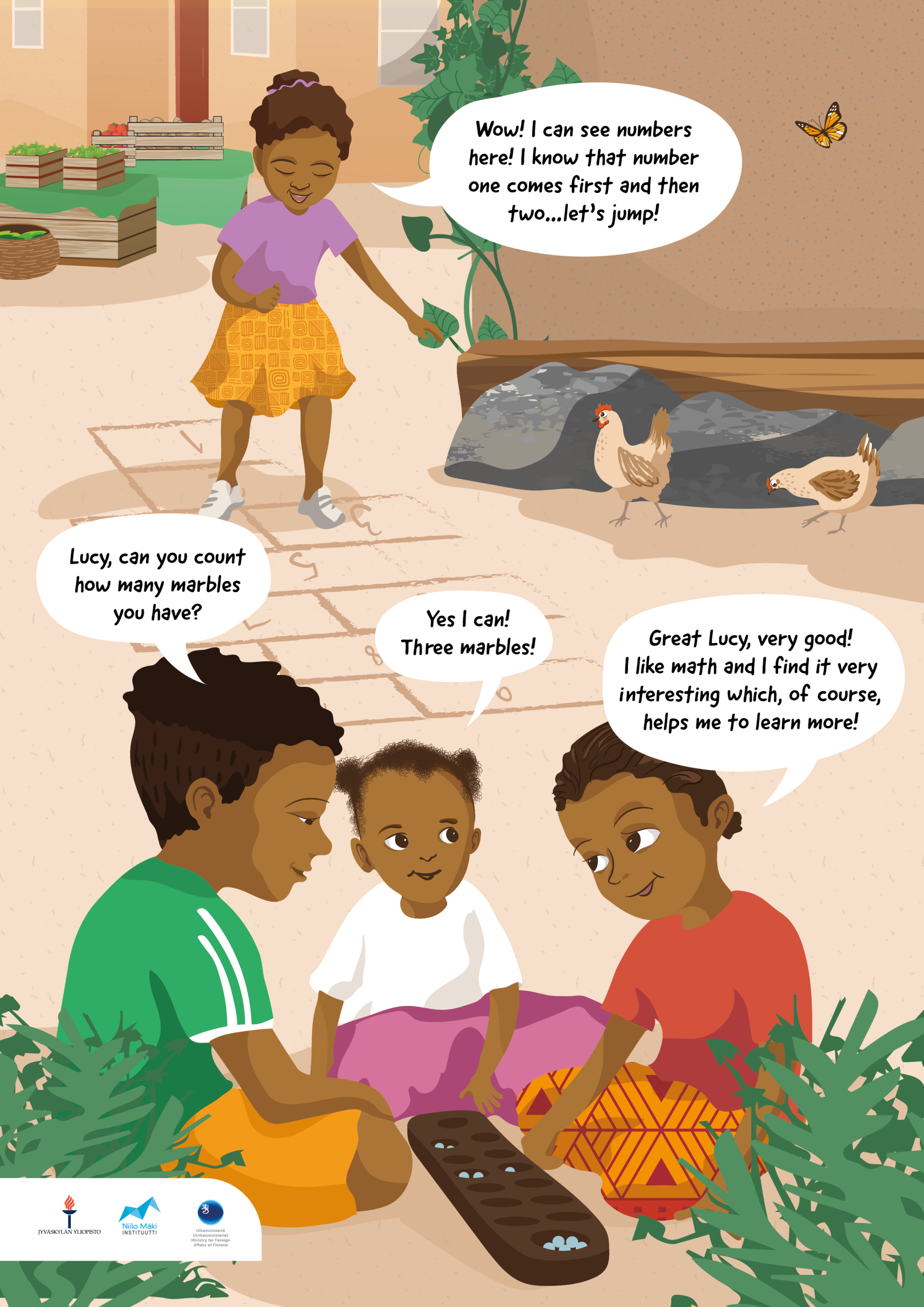
As children begin to grasp number concepts, they learn to link small number words with actual quantities to develop their understanding of cardinality—the idea that a number word reflects the total amount in a set.
For quantities larger than four, determining the exact number (‘how many’) requires counting. Counting relies heavily on knowledge of the number sequence and on mastering its principles.
Early maths skills refer to the foundational mathematical abilities developed in early childhood, encompassing numeracy skills and broader domains including logical reasoning, recognition of patterns and regularities, spatial and geometric understanding, measurement, problem-solving and mathematical language use (for a review and theoretical model, see Parviainen, 2024). In this section, we focus mainly on early numeracy skills. Geometric skills are described in Basic Maths Skills and measurement is described in Advanced and Applied Maths Skills. Mathematical language and problem-solving are presented in their own sections.
Early numeracy has been conceptualized by Raghubar and Barnes (2017) as an umbrella term that encompasses skills such as recognizing quantities, detecting the changes and differences in quantities, verbal counting, knowing the number symbols and their cardinal and ordinal meanings, discerning number patterns, comparing numerical magnitudes and manipulating quantities (i.e. adding and subtracting objects from a set). Early numeracy skills include understanding symbolic numbers, such as the count sequence and the meaning of number words and Arabic numerals (0, 1, 2, 3, 4, 5, 6, 7, 8, 9) (Göbel et al., 2014; Merkley & Ansari, 2016). Early numeracy skills can be acquired informally prior to or outside of school, when children begin exploring their surroundings and start noticing the size and shape of their toys and other objects (Raghubar & Barnes, 2017). In African contexts, early numeracy skills often emerge through everyday household activities. For instance, young children in rural communities may assist their parents in sorting and counting agricultural produce, such as beans or mahangu (pearl millet). Through these tasks, children develop foundational numeracy concepts of counting, comparison, size discrimination and classification, long before their formal education begins.
In other words, the foundations of mathematical skills start developing very early, with some abilities considered innate. For example, infants can distinguish between small quantities, like one, two and three, and can tell apart sufficiently large differences between quantities. These abilities are thought to rely on two distinct systems for processing small and large quantities, each with separate neural bases (Feigenson et al., 2004). The concept of number sense refers to the innate ability to estimate and compare quantities without counting (e.g. recognizing that eight apples is more than five (Butterworth et al., 2011). Although number sense is believed to be inborn, it undergoes developmental changes. Individual differences in number sense have been linked to variations in early numeracy development and later mathematical achievement (Geary et al., 2015). There are also broader definitions of number sense that cover a set of foundational numerical competencies, including understanding quantities, magnitude relations, counting principles, and the flexible manipulation of numerical information.
Additional reading
Number concept
Very young children may understand concepts describing approximate quantities (e.g. a lot, more, a little) before they grasp the exact meanings of number words (e.g. one, two). Precise distinction between small quantities is thought to be a key prerequisite for learning number concepts that relate to exact quantities. At 2–2.5 years of age, a child usually learns that the word ‘one’ means a quantity containing one thing or object (Wege et al., 2025; Wynn, 1992). Then, the child learns the meaning of the words ‘two’ and ‘three’. By 3.5–4 years of age, the child will usually have learnt the association between the words ‘one’, ‘two’ and ‘three’ and their corresponding quantities. This is when they are able to, for example, hand over three sweets when asked; with larger numbers, they may still be inaccurate and give a handful when asked for five. For a young child, the numbers five and above will initially mean an imprecise quantity of ‘many’. After children have learnt to associate small quantities with number words, they will learn to map them with corresponding written number symbols (Lira et al., 2017). Fast processing of numerical symbols is required for many mathematical tasks, such as calculating fluently, which is why the ability to associate numbers, numeral words and quantities is considered basic in mathematics.
Number word-sequence skills.
Alongside the development of the link between quantities, number words and numbers, around the age of 2, the child starts to learn the sequence of number words (i.e. ‘one, two, three…’). Later on, the number sequence will be a key tool for the accurate determination of quantities of four and above. At the beginning of this development, the number sequence takes the form of a nursery rhyme; the words are not distinct from each other and are not yet meaningful in a quantitative sense (Fuson, 1988). Gradually, the child learns to distinguish between individual counting words and learns the correct order of the words for small numbers. Through practice, the sequence of counting words becomes automatic, the ability to recite numbers becomes more fluent and the child will be able to recite numbers starting from the middle of the number sequence. In addition, the child can recite the sequence backwards over a longer range of numbers. The ability to recite number words can be considered a core number skill that is essential for mental calculations and the exact enumeration of quantities larger than five. Importantly, number sequence skills assessed at pre-primary education age are known to predict the level of mathematical skills at school age (e.g., Koponen et al., 2007, 2019).
Enumeration skills.
Our innate ability to accurately distinguish quantities is limited to small numbers, typically 1–3 or 1–4. The ability to recognize a small quantity at a glance—called ‘subitizing’—is useful in many daily situations when we need to name a quantity, write the corresponding numeral, or create a matching set of objects (e.g. bring out the same number of plates as glasses). For quantities larger than four, determining the exact number (‘how many’) requires counting. Counting relies strongly on number sequence skills. However, in order for number sequence skills to become a useful tool for calculation, the child must be able to link sequential information about the order of numbers to the size relationships between numbers. An essential stage in the development of number sequence skills is when the child realizes that the last number listed represents the quantity of the entire set. This is referred to as the realization of the cardinality principle (Gelman & Gallistel, 1978). This is supported by the child’s existing knowledge of the association between numerical words and quantities for small numbers (e.g. there are three children in the family). When the child reaches the same conclusion by reciting the number sequence ‘one, two, three’, they begin to understand the quantitative meaning of the number sequence. After this realization, the child will be able to use a number sequence to accurately determine quantities—that is, to calculate. Typically, a child forms this connection around the age of 4 (Sarnecka & Carey, 2008). Using a number sequence as a calculation tool requires mastery of principles other than cardinality. The child needs to be able to recite the numbers in the correct order and count each item, but only once. This means that the child needs to understand one-to-one correspondence and be able to follow this principle when counting items. Enumeration can also occur through conceptual subitizing, which refers to the ability to perceive a larger quantity by recognizing it as a combination of smaller, familiar groups—for example, seeing six as ‘three and three’ or ‘four and two’—rather than counting each item individually. However, this already requires the ability to add quantities, unless the child is recognizing a familiar pattern (for example, the dot pattern representing six on a die).
Mathematical-logical skills
Mathematical-logical thinking and reasoning processes generally require an understanding of the associations and interrelationships between objects, items, number symbols, quantities and their features. Children learn to search for certain structures and regularities to order, predict and create cohesion (Sarama & Clements, 2009; Schultz, Gopnik & Glymour, 2007). Hence, mathematical-logical thinking and reasoning processes guide children on how to use problem-solving and reasoning strategies that emerge early in their lives (Clements & Sarama, 2007).
Children’s ability to classify and compare different attributes or features expands significantly between ages 3 and 6 (Sarama & Clements, 2009). During this period, children discover associations and repeatable sequences and use them to reach conclusions about features and quantities by categorizing things and objects (Vanluydt et al., 2021). Learning comparison and repeatable sequences means, for instance, that around age 4, children learn to compare length directly, whereas at age 5, they can arrange length according to serial order (Clements & Sarama, 2021). In addition, with age, children learn to sort objects according to a single attribute and can eventually reclassify them by changing the attribute. Gradually, they learn to classify and seriate according to two attributes simultaneously. Children’s mathematical problem-solving and reasoning strategies become more sophisticated with age; they learn multiple problem-solving methods and come to understand part–whole relations and principles of data modelling (Alsina & Saldago, 2022; Mulligan, 2015; Vanluydt et al., 2021).
References
Alsina, Á., & Salgado, M. (2022). Understanding early mathematical modelling: First steps in the process of translation between real-world contexts and mathematics. International Journal of Science and Mathematics Education, 20(8), 1719-1742.
Butterworth, B., Varma, S., & Laurillard, D. (2011). Dyscalculia: from brain to education. science, 332(6033), 1049-1053.
Clements, D. H., & Sarama, J. (2007). Early childhood mathematics learning. In F. K. Lester, Jr. (Ed.), Second handbook of research on mathematics teaching and learning (pp. 461–558). Information Age Publishing.
Clements, D. H., & Sarama, J. (2021). Learning and teaching early maths: The learning trajectories approach (3rd ed.). Taylor & Francis.
Feigenson, L., Dehaene, S., & Spelke, E. (2004). Core systems of number. Trends in cognitive sciences, 8(7), 307-314.
Fuson, K. C. (1988). Children’s counting and concepts of number. New York: Springer.
Geary, D. C. (2015). Evolution of paternal investment. The handbook of evolutionary psychology, 483-505.
Gelman, R., & Gallistel, C. R. (1978). The child’s understanding of number. Cambridge, MA: Harvard University Press. Greenberg, J. H
Göbel, S. M., Watson, S. E., Lervåg, A., & Hulme, C. (2014). Children’s arithmetic development: It is number knowledge, not the approximate number sense, that counts. Psychological science, 25(3), 789-798.
Koponen, T., Aunola, K., Ahonen, T., & Nurmi., J-E. (2007). Cognitive predictors of single-digit and procedural calculation and their covariation with reading skill. Journal of Experimental Child Psychology, 97, 220-241.
Koponen, T., Aunola, K., & Nurmi, J-E., (2019). Verbal counting skill predicts later maths performance and difficulties in middle school. Contemporary Educational Psychology, 59, 1-8.
Lira, C. J., Carver, M., Douglas, H., & LeFevre, J. A. (2017). The integration of symbolic and non-symbolic representations of exact quantity in preschool children. Cognition, 166, 382–397. https://doi.org/10.1016/j.cognition.2017.05.033
Merkley, R., & Ansari, D. (2016). Why numerical symbols count in the development of mathematical skills: Evidence from brain and behavior. Current Opinion in Behavioral Sciences, 10, 14-20.
Mulligan, J. (2015). Looking within and beyond the geometry curriculum: connecting spatial reasoning to mathematics learning. Zdm, 47(3), 511-517.
Raghubar, K. P., & Barnes, M. A. (2016). Early numeracy skills in preschool-aged children: a review of neurocognitive findings and implications for assessment and intervention. The Clinical Neuropsychologist, 31(2), 329–351. https://doi.org/10.1080/13854046.2016.1259387
Sarnecka, B. W., & Carey, S. (2008). How counting represents number: What children must learn and when they learn it. Cognition, 108, 662–674. https://doi.org/10.1016/j.cognition.2008.05.007
Schulz, L. E., Gopnik, A., & Glymour, C. (2007). Preschool children learn about causal structure from conditional interventions. Developmental science, 10(3), 322-332.
Vanluydt, E., Wijns, N., Torbeyns, J., & Van Dooren, W. (2021). Early childhood mathematical development: the association between patterning and proportional reasoning. Educational Studies in Mathematics, 107(1), 93-110.
Wege, T. E., Gilmore, C., & Inglis, M. (2025). Children’s early understanding of the successor function. Journal of Numerical Cognition, 11, 1-18.
Wynn, K. (1992). Children’s acquisition of number words and the counting system. Cognitive Psychology, 24, 220–251.