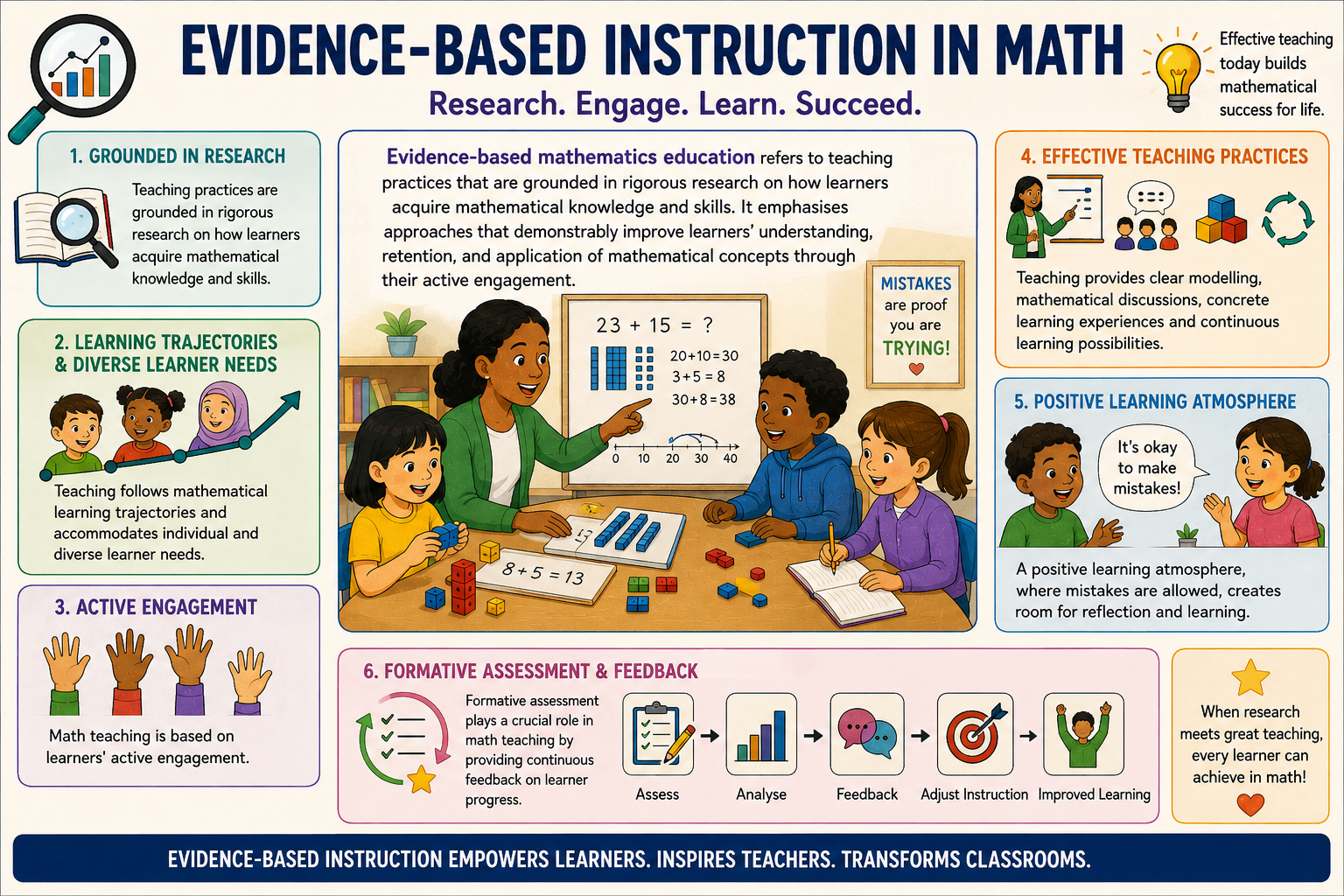
Teaching practices are grounded in rigorous research on how learners acquire mathematical knowledge and skills.
Teaching follows mathematical learning trajectories and accommodates individual and diverse learner needs.
Maths teaching is based on learners’ active engagement.
Teaching provides clear modelling, mathematical discussion, concrete learning experiences, and continuous opportunities for learning.
A positive learning atmosphere, where mistakes are viewed as opportunities for learning, creates space for reflection and growth.
Formative assessment plays a crucial role in maths teaching by providing continuous feedback on learner progress.
Evidence-based mathematics instruction refers to teaching practices grounded in rigorous research on how learners acquire mathematical knowledge and skills. Drawing on research from Mathematics Education, Cognitive Science, and Educational Psychology, such instruction emphasises approaches that demonstrably improve learners’ understanding, retention, and application of mathematical concepts (National Research Council, 2001). In elementary education, the adoption of evidence-based strategies is particularly important, as it establishes the foundation for later mathematical competence and confidence.
Teaching follows learning trajectories
Teachers’ understanding of developmental progressions, or learning trajectories, should guide their maths teaching (Learning mathematical skills). Teaching should provide activities and experiences that support children’s progression in mathematical thinking. It is important to recognise that learning trajectories are individual and are influenced by cultural and environmental factors. They should not be viewed as universal, strictly linear, or tied to specific ages.
Conceptual understanding and procedural fluency
A central principle of effective mathematics instruction is the integration of conceptual understanding and procedural fluency. Research indicates that learners benefit most when they understand the underlying principles of mathematical operations rather than relying solely on memorisation (Kilpatrick, Swafford, & Findell, 2001). Instruction informed by constructivist principles supports active learner engagement, whereby knowledge is constructed through interaction with ideas, materials, and peers. Teachers are therefore encouraged to use multiple representations and authentic contexts to deepen learners’ understanding.
The Concrete–Representational–Abstract (CRA) approach
The Concrete–Representational–Abstract (CRA) approach is widely supported by research as an effective instructional strategy, particularly in the early years and in inclusive educational settings (Witzel, Mercer, & Miller, 2003). This approach enables learners to progress from concrete experiences, such as using manipulatives, to visual representations and finally to abstract symbols. The CRA approach is especially beneficial for learners with diverse learning needs, as it scaffolds understanding and helps to reduce cognitive overload.
Explicit and systematic instruction
Explicit instruction, characterised by clear modelling, guided practice, and structured sequencing, has been shown to significantly enhance learner outcomes (Archer & Hughes, 2011). Through explicit instruction, teachers make cognitive processes visible by thinking aloud, demonstrating problem-solving procedures, and gradually transferring responsibility to learners. This approach is particularly effective for developing foundational numeracy skills and supporting learners who require additional assistance.
Formative assessment and feedback
Formative assessment plays a crucial role in evidence-based instruction by providing continuous feedback on learner progress. Black and Wiliam (1998) emphasise that ongoing assessment enables teachers to identify misconceptions and adapt instruction accordingly. Effective formative assessment strategies include questioning, observation, and short assessment tasks that inform immediate instructional decisions.
Mathematical discourse and language development
Encouraging mathematical discourse enhances learners’ reasoning, communication, and problem-solving skills. When learners articulate their thinking, justify their solutions, and engage in discussion with peers, they develop a deeper conceptual understanding of mathematics (Mercer & Sams, 2006). This is particularly important in multilingual contexts, where language development and mathematical learning are closely interconnected.
Spaced practice and retrieval
Research on the spacing effect demonstrates that learning is strengthened when practice is distributed over time rather than concentrated within a single session. Spaced practice, combined with opportunities for retrieval, enhances long-term retention and transfer of knowledge (Rohrer, 2012). Teachers should therefore revisit key concepts regularly and incorporate cumulative review into their lessons.
Addressing misconceptions
Learners often develop misconceptions that can hinder mathematical progress if left unaddressed. Effective instruction involves anticipating common errors, using diagnostic assessment, and explicitly challenging incorrect reasoning (Swan, 2005). A positive view of mistakes recognises errors as valuable opportunities for learning rather than signs of failure. When learners make mistakes, they reveal their thinking, enabling teachers to identify misconceptions and adapt instruction accordingly.
Research in Mathematics Education suggests that engaging with errors supports deeper conceptual understanding and promotes reasoning and persistence (Borasi, 1994; Boaler, 2016). Creating a classroom culture in which mistakes are openly discussed aligns with constructivist principles and encourages learners to take risks, reflect on their thinking, and develop more accurate mathematical understanding (Hiebert et al., 1997). Reflection, discussion, and peer support can further enhance learning; however, teachers must remain aware of misconceptions and actively support conceptual change and deeper understanding.
Inclusive mathematics instruction
Inclusive education requires teaching strategies that accommodate diverse learner needs. The Universal Design for Learning (UDL) framework advocates providing multiple means of representation, engagement, and expression (Meyer, Rose, & Gordon, 2014). In mathematics classrooms, this may involve the use of visual supports, structured routines, and adapted materials, particularly for learners with disabilities, including those with hearing impairments.
Implications for practice
For effective implementation, teachers should:
integrate conceptual understanding and procedural fluency,
use structured and explicit instructional methods,
employ ongoing formative assessment,
encourage learner interaction and mathematical discourse, and
Apply inclusive strategies to support all learners.
Sustained professional development, including coaching and collaborative reflection, is essential to ensure that these practices are effectively implemented in classroom settings.
Evidence-based mathematics instruction provides a robust framework for improving teaching and learning in classrooms. By aligning instructional practices with research-informed principles, teachers can enhance learner achievement, promote equity, and foster a deeper appreciation of mathematics.
References
Archer, A. L., & Hughes, C. A. (2011). Explicit instruction: Effective and efficient teaching. Guilford Press.
Black, P., & Wiliam, D. (1998). Assessment and classroom learning. Assessment in Education: Principles, Policy & Practice, 5(1), 7–74.
Boaler, J. (2016). Mathematical mindsets: Unleashing students’ potential through creative math, inspiring messages and innovative teaching. Jossey-Bass.
Borasi, R. (1994). Capitalizing on errors as “springboards for inquiry”: A teaching experiment. Journal for Research in Mathematics Education, 25(2), 166–208.
Hiebert, J., Carpenter, T. P., Fennema, E., Fuson, K. C., Wearne, D., Murray, H., Olivier, A., & Human, P. (1997). Making sense: Teaching and learning mathematics with understanding. Heinemann. Kilpatrick, J., Swafford, J., & Findell, B. (Eds.). (2001). Adding it up: Helping children learn mathematics. National Academy Press.
National Research Council. (2001). Adding it up: Helping children learn mathematics. National Academy Press.
Mercer, N., & Sams, C. (2006). Teaching children how to use language to solve maths problems. Language and Education, 20(6), 507–528.
Meyer, A., Rose, D. H., & Gordon, D. (2014). Universal design for learning: Theory and practice. CAST Professional Publishing.
Rohrer, D. (2012). Distributed practice in mathematics learning: Improving retention and transfer. Psychological Science, 23(6), 645–650.
Swan, M. (2005). Improving learning in mathematics: Challenges and strategies. Department for Education and Skills.
Witzel, B. S., Mercer, C. D., & Miller, M. D. (2003). Teaching algebra to students with learning difficulties: An investigation of an explicit instruction model. Learning Disabilities Research & Practice, 18(2), 121–131.