Fractions can be conceptualised in multiple ways beyond the common part–whole interpretation. These include fractions as ratios, operators, measures, and quotients.
Understanding these diverse conceptualisations is essential for developing a comprehensive understanding of fractions.
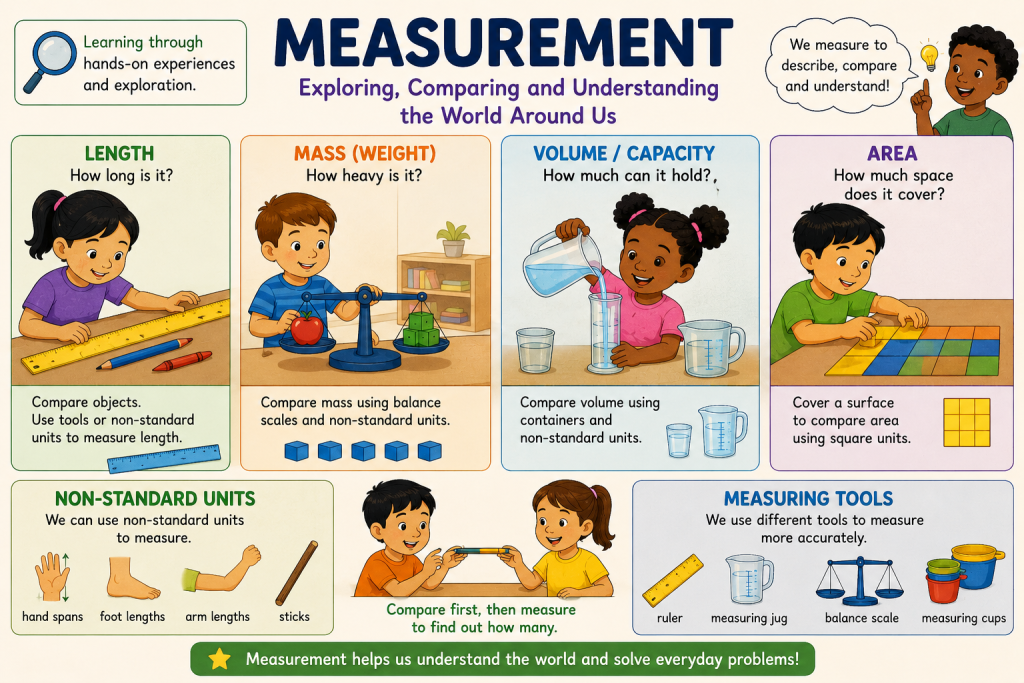
Learning measurement is best supported through concrete experiences and exploration of length, area, mass, and volume/capacity.
Teaching Fraction Skills
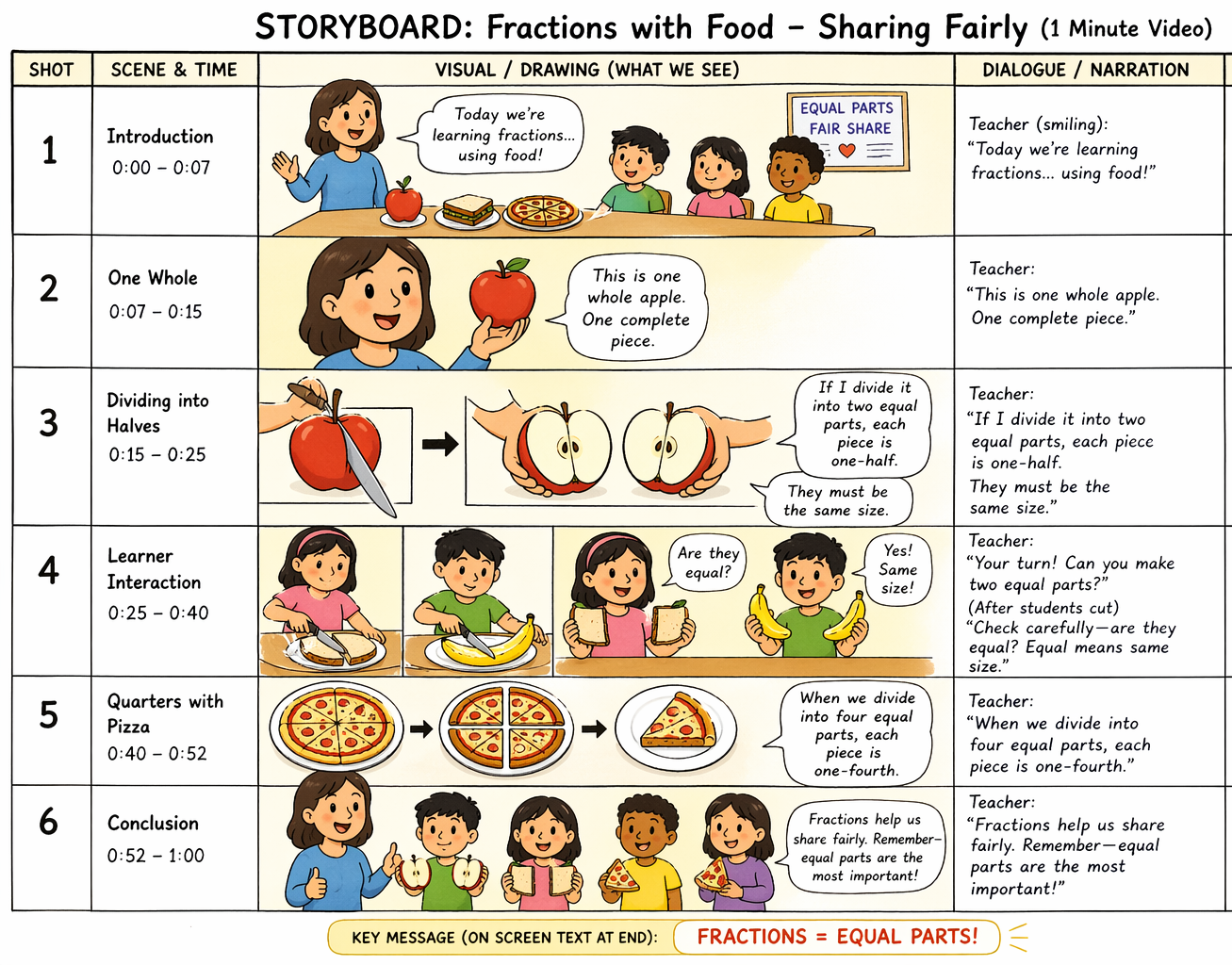
From a young age, children are interested in equal or fair sharing to avoid unhappiness. This creates concrete hands-on experiences of sharing cookies or sweets, laying the foundation for fraction knowledge. Fractions can be conceptualized in multiple ways, beyond the common “part–whole” concept. These include fractions as ratios, operators, measures, and quotients, each offering a unique perspective on their meaning and application (Lamon, 2007). Understanding these diverse conceptualizations is crucial for developing a comprehensive understanding of fractions.
In early years teaching, emphasis should be placed on part–whole, division, and measurement interpretations (Van de Walle et al., 2014). Children should be given opportunities to experience different meanings of fractions through practical, play-based, and experiential activities. At this stage, learners typically describe fractions informally using terms such as “piece” or “equal sharing”, rather than formal fraction notation, which is introduced later in primary education.
The part–whole interpretation is the most familiar representation, in which a fraction describes a portion of a whole object, set, or quantity. For example, 1/2 represents one of two equal parts of an orange that has been shared.
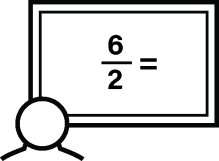
The ratio interpretation describes a fraction as a relationship between two quantities expressed as a comparison (e.g., 1 in 4 learners) (Lamon, 2007). The operator interpretation treats a fraction as an operation applied to a quantity; for example, “half of 10” involves dividing 10 into two equal parts, resulting in 5 (Van de Walle et al., 2018). Fractions can also be understood as a quotient, where the numerator is divided by the denominator; for example, 5/2 represents 5 divided by 2, which equals 2.5 (Charles et al., 2012). In the measure interpretation, a fraction represents a position or length on a number line; for example, 3/4 is located between 0 and 1 on a number line (Lamon, 2007).
These conceptualisations are interconnected and mutually reinforcing. For example, understanding fractions as both part–whole and ratios can support learners in solving proportion problems more effectively.
Teaching fraction concepts in early childhood education (ECE) should therefore emphasise hands-on, visual, and experiential learning, focusing on understanding parts of a whole rather than abstract symbols (Clements & Sarama, 2014). The use of real objects, manipulatives, and everyday contexts helps learners develop an intuitive understanding of fractions as equal parts of a whole.
A useful starting point for preschool learners is sharing concrete quantities, such as distributing six beans between two or three dolls. Through such activities, learners observe that increasing the number of recipients reduces the amount each receives. Formal fraction notation is introduced later, once learners have developed sufficient conceptual understanding of numerators and denominators through repeated practical experiences and verbal explanations.
Use of concrete objects
Food items provide meaningful contexts for exploring fractions. Learners can physically divide items into equal parts, with emphasis placed on equal partitioning and fairness (Van de Walle et al., 2018).
Visual models
Visual representations such as circles, strips, fraction walls, and number lines support conceptual understanding (Charles et al., 2012).
Real-life connections
Fractions can be linked to everyday experiences such as sharing food, dividing fruit, or measuring ingredients in recipes (Clements & Sarama, 2014).
Hands-on activities
Activities involving cutting, folding, and manipulating fraction materials help reinforce understanding. Games and playful activities can further support engagement and conceptual learning (National Council of Teachers of Mathematics [NCTM], 2013).
By combining varied hands-on activities with meaningful real-world examples, teachers can support young learners in developing a strong foundational understanding of fractions before progressing to symbolic representation.
Learning measurement is best supported through concrete experiences and exploration of length, area, mass, and volume/capacity. Early measurement instruction begins with direct comparison of objects, as this helps children understand that different attributes can be measured and ordered according to mathematical properties (Clements & Sarama, 2021).
Instruction should then progress to the use of non-standard units (e.g., body parts, sticks, or informal tools), which help learners understand relationships between attributes such as length and number, mass and number, and volume and number (Sarama & Clements, 2009; Cheeseman et al., 2014). Measurement learning should also include the use of appropriate tools such as balancing scales and containers of different shapes and sizes, which should be made available for play and exploration (Parviainen et al., 2024).
Learners also need to develop awareness of the attribute being measured (i.e., measurement concepts). Concrete exploration of measurable attributes supports conceptual development when teachers intentionally connect measurement language to real-life situations (Cheeseman et al., 2014; Lee et al., 2016). For example, length can be explored through direct comparison (shorter/longer, taller/shorter) and ordering (from shortest to longest) (Clements & Sarama, 2021).
Similar approaches apply to other measurement domains. In area, learners compare objects using terms such as smaller/larger. In mass, comparisons may include lighter/heavier or lightest/heaviest. In volume or capacity, learners use terms such as fuller/emptier, more/less, or fewer/greater. The consistent use of accurate mathematical language by teachers is important in supporting the development of measurement concepts.
Practicing these concepts can take place through both free play and guided play. Below are examples of each:
Free play
Provide materials such as cups, bowls, spoons, sand, sticks of equal length, plastic toys of varying heights, boxes, shapes of equal size, balancing scales, and stones of different sizes.
Structured play
Provide materials and scaffold learning through guided questioning, for example:
“You want to fill this big bowl with sand. What will you use to fill the bowl with sand? (Cups, not spoons as it will take too long.) How many (cups) were needed?
“You want to fill this cup with sand. What will you use? How many were needed?”
“You want to find out how tall this toy giraffe is. What will you use? How many were needed?”
“You want to build a car with the shapes. What shapes can you use? Show me.”
“Build anything that you want with the shapes.”
As children develop a more sophisticated understanding of time and time-related terminology (Lyytinen, 2014; Mulligan & Mitchelmore, 2013), measurement instruction should also include time concepts. Time can be explored using concrete tools, such as timers and hourglasses, while collecting toys or doing physical exercise. Providing such tools for play further supports understanding of time as a measurable concept (Parviainen et al., 2024).
Time understanding also includes sequencing events. Learners can practise ordering sequences of familiar activities, such as morning routines, puzzle completion, or baking, by arranging pictures from beginning to end. Such activities support the development of temporal reasoning and understanding of chronological order.
Charles, R. I., Lester, F. K., & O’Daffer, P. G. (2012). How to evaluate progress in problem solving. Pearson Education.
Clements, D. H., & Sarama, J. (2014). Learning and teaching early math: The learning trajectories approach (2nd ed.). Routledge.
Lamon, S. J. (2007). Teaching fractions and ratios for understanding: Essential content knowledge and instructional strategies (2nd ed.). Routledge.
National Council of Teachers of Mathematics. (2013). Principles to actions: Ensuring mathematical success for all. NCTM.
Siegler R.S., & Pyke, A.A (2013). Developmental and individual differences in understanding of fractions. Developmental Psychology, 49(10), 1994 – 2004. https://doi.org/10.1037/a0031200.
Van de Walle, J. A., Karp, K. S., & Bay-Williams, J. M. (2018). Elementary and middleschool mathematics: Teaching developmentally (10th ed.). Pearson.
Van de Walle, J. A., Karp, K. S., & Bay-Williams, J. M. (2014). Teaching Student-Centered Mathematics. Developmentally Appropriate Instruction for Grades Pre-K-2. (2 nd Ed) Pearson
Cheeseman, J., McDonough, A., & Ferguson, S. (2014). Investigating young children’s learning of mass measurement. Mathematics Education Research Journal, 26, 131–150. https://doi.org/10.1007/s13394-011-00002-7
Clements, D. H., & Sarama, J. (2021). Learning and teaching early math: The learning trajectories approach (3rd ed.). Taylor & Francis.
Lee, J., Collins, D., & Melton, J. (2016). What does algebra look like in early childhood? Childhood Education, 92(4), 305–310. https://doi.org/10.1080/00094056.2016.1208009
Lyytinen, P. (2014). Kielenkehityksen varhaisvaiheet [Early phases of language development]. In T. Siiskonen, T. Aro, T. Ahonen, & R. Ketonen (Eds.), Joko se puhuu? Kielenkehityksen vaikeudet varhaislapsuudessa [Does it speak already? Difficulties related to language development in early childhood] (pp. 51–71). PS-Kustannus.
Mulligan, J., & Mitchelmore, M. (2013). Early awareness of mathematical pattern and structure. In L. Y. English & J. T. Mulligan (Eds.), Reconceptualizing early mathematics learning (pp. 29–45). Springer.
Parviainen, P., Eklund, K., Koivula, M., Liinamaa, T., & Rutanen, N. (2024). Enhancing Teachers’ Pedagogical Awareness of Teaching Early Mathematical Skills: A Mixed Methods Study of Tailored Professional Development Program. Early Education and Development, 35(5), 1103-1125. https://doi.org/10.1080/10409289.2024.2336661
Sarama, J., & Clements, D. (2009). Early childhood mathematics education research. Learning trajectories for young children. Routledge.