Children build mathematical understanding and calculation strategies gradually through experiences that help them recognise quantities, identify relationships between numbers, and understand why different calculation strategies work.
It is important that, from the outset, children have access to effective calculation strategies that integrate procedural fluency and conceptual understanding.
When teaching multi-digit arithmetic, instruction should support children in developing robust conceptual understandings of multi-digit numbers and applying these understandings in calculation.
Understanding place value and the base-ten system is a strong predictor of later success in arithmetic and problem-solving.
In geometry, learners should be provided with opportunities to explore a variety of shapes in order to develop a broad understanding of their characteristics and forms.
Teaching Strategies to Support Arithmetic Skill Development
The development of arithmetic skills begins with counting aloud and using concrete tools such as fingers, bead strings, and number lines. Gradually, children move towards mental calculation and eventually to retrieving answers to well-practised arithmetic facts directly from memory (Arithmetic skills).
Effective teaching of arithmetic in the early years involves more than practising arithmetic facts or demonstrating calculation steps. Children build mathematical understanding gradually through experiences that help them recognise quantities, identify relationships between numbers, and understand why different calculation strategies work.
To support this development, teachers need to draw upon different types of mathematical knowledge and provide learning opportunities that strengthen each of them. In arithmetic strategy instruction, it is important to tailor tasks to children’s current strategy levels, encourage them to explain and reflect upon their strategies, and provide explicit strategy instruction, particularly for learners who are experiencing difficulties (Hickendorff et al., 2019).
Different instructional approaches build on three key components of: factual knowledge (what?), procedural knowledge (how?), and conceptual knowledge (why?) (Koponen et al., 2009, 2018). These components work together to form the foundation for children’s ability to solve problems flexibly and efficiently. A strong conceptual understanding of arithmetic operations is essential and can be supported by presenting calculations within a variety of meaningful problem-solving contexts. (Teaching problem solving)
Single-digit arithmetic
Arithmetic instruction begins with calculations involving single-digit numbers. From the outset, children should have access to the most effective calculation strategies possible. This requires the integration of procedural knowledge, fact knowledge, and conceptual understanding, while also taking into account each child’s current level of number-sequence knowledge (e.g., whether the child can count forwards and backwards from a given number) and understanding of number concepts.
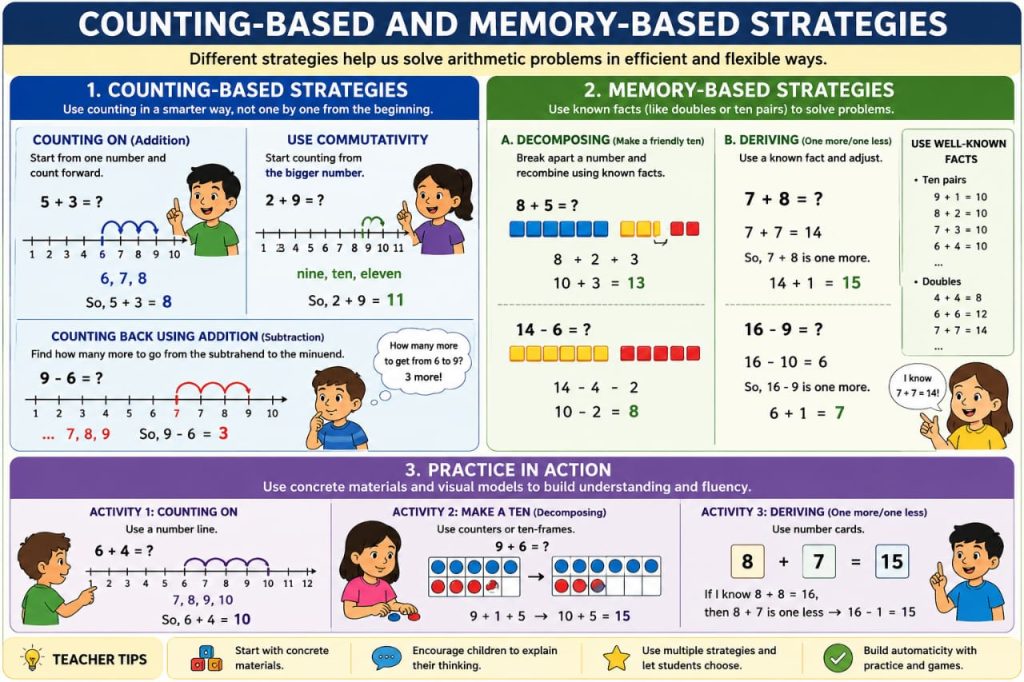
Counting-based and memory-based strategies
When solving arithmetic problems through counting, efficiency increases as learners become less reliant on counting one by one. For example, in addition, children can learn to count on from one of the numbers rather than beginning the count from one.
For example, with 5 + 3, you take 5 and count onwards: 6, 7, 8.
For example:
5 + 3
Start with 5 and count on:
5, 6, 7, 8
This strategy requires children to develop number-sequence knowledge so that they can begin reciting number words from the middle of a sequence rather than from the beginning.
A further development involves applying the principle of commutativity by starting with the larger number:
2 + 9
Start with 9 and count on:
9, 10, 11
In subtraction, learners can use addition to determine the difference between two numbers:
9 − 6
Count on from 6:
6, 7, 8, 9
Therefore, 9 − 6 = 3.
Repeated practice
Repeated practice aims to support the formation and retrieval of number combinations and arithmetic facts (e.g., 5 + 5 = 10; 6 − 2 = 4; 5 × 4 = 20) through extensive practice and immediate feedback. Such practice is often accompanied by time constraints that encourage learners to retrieve answers directly from memory rather than calculate them anew.
Digital applications are frequently used because they can provide immediate and consistent feedback while allowing teachers to monitor progress. Other methods for improving calculation fluency through repetition include board games, card games, and timed written calculations.
Materials and instructions for games can be found at these links:
Addition, Subtraction and Multiplication Cards and Tables
For some children, repetition-based practice alone does not lead to the automatisation of arithmetic facts. These learners may require explicit instruction and support in developing memory-based calculation strategies to improve fluency.
Memory‑based strategies involve solving problems by drawing upon well-established arithmetic facts, such as number bonds to ten (e.g., 9 + 1; 7 + 3) or doubles (e.g., 4 + 4; 7 + 7).
One approach is decomposing, which involves partitioning and recombining numbers:
8 + 5 → 8 + 2 + 3 → 10 + 3 = 13
14 − 6 → 14 − 4 − 2 → 10 − 2 = 8
Another approach is deriving, in which learners use a known fact to solve a related problem:
7 + 8
7 + 7 = 14, therefore 7 + 8 is one more = 15
16 − 9
16 − 10 = 6, therefore 16 − 9 is one more = 7
In early mathematics instruction, teachers can support these strategic approaches by providing varied and concrete learning experiences. Below is a description of what each knowledge type looks like in practice, with clear classroom examples.
Multi-digit arithmetic
When teaching multi-digit arithmetic, instruction should support children in constructing accurate and robust conceptual understandings of multi-digit numbers and in applying these understandings during calculation (Fuson & Briars, 1990).
The learning of multi-digit numbers and operations should be approached as a conceptual problem-solving activity rather than as the transmission of fixed rules and procedures. Instruction should not assume that all learners use the same method, nor should it focus exclusively on teaching a single standard algorithm.
Instead, learners should be given ample time to develop their own solution strategies. Opportunities should also be provided for them to share, discuss, and compare different approaches. These discussions may involve addition and subtraction tasks, place-value problems, and, where appropriate, multiplication and division.
The aim is to help learners understand the importance of selecting an appropriate strategy for solving a given problem and to support learning through reflection on and evaluation of alternative approaches.
Calculation strategy
Examples in addition
Decomposing
Decompose both numbers and combine by place value.
58 + 26 = 50 + 20 and 8 + 6 → 70 + 14 = 84
Decompose one addend and add stepwise.
58 + 26 → 58 + 20 + 6
Transforming
Rounding
58 + 26 → 60 + 26 − 2
Compensation (balancing)
58 + 26 = 60 + 24
Calculation strategy
Examples in subtraction
Decomposing
Decompose both numbers and subtract by place value.
58 − 26 = (50 − 20) and (8 − 6) → 30 + 2 = 32
Decompose one number and subtract stepwise.
58 − 26 → 58 − 20 − 6
Transforming
Rounding
52 − 28 → 52 − 30 + 2
Mental calculation strategies cannot be ranked in a fixed hierarchy of effectiveness. The suitability of a strategy depends on the characteristics of the problem, such as the size of the numbers involved and the presence of carrying or borrowing operations. It also depends on the learner’s mastery of different strategies.
Skilled calculators are distinguished precisely by how efficiently they can adapt to the demands of a given problem and select the most suitable strategy. In contrast, less skilled calculators are less able to choose appropriate strategies and may rely on a single approach, such as decomposition, which is not always the easiest or most efficient method, especially in problems involving carrying or borrowing.
It is therefore important that children have opportunities to explore numbers so that decomposing and transforming them becomes fluent and they develop a range of flexible and versatile calculation strategies.
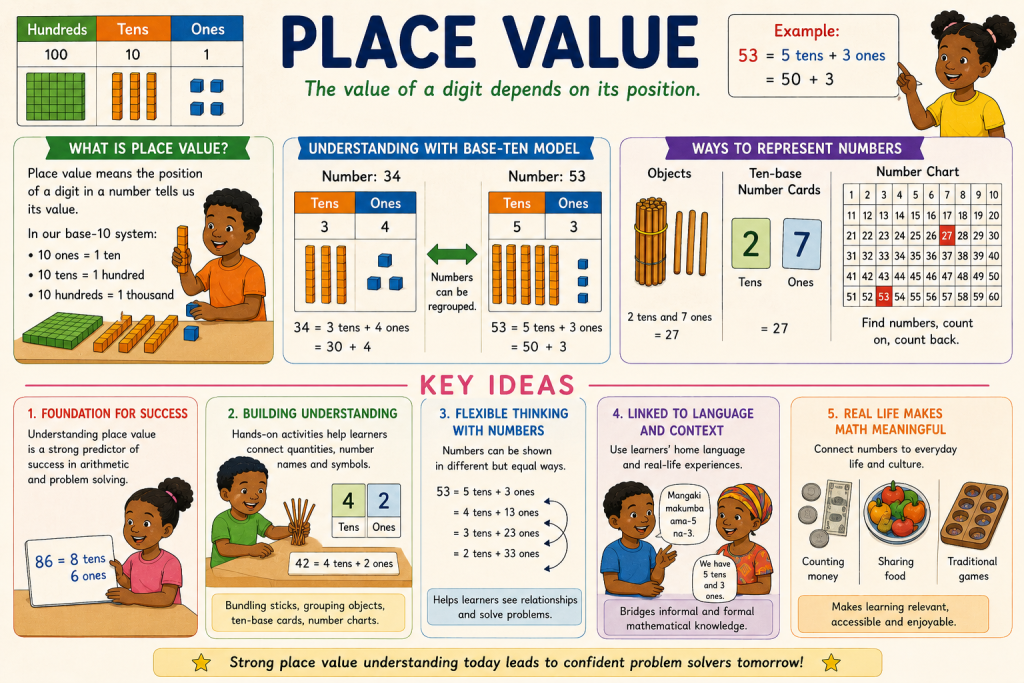
Place-value knowledge is a critical foundation for mathematics learning, as it helps learners understand that the value of a digit depends on its position within a number. Research shows that understanding place value and the base-ten system is a strong predictor of later success in arithmetic and problem-solving, and that many learners experience difficulties when these concepts are not well developed (Moeller et al., 2011).
The base-10 number system, which organises numbers into tens, hundreds, and beyond, enables learners to represent and interpret quantities efficiently. It also supports flexible thinking about numbers, such as recognising that 53 can be understood as 5 tens and 3 ones, or regrouped in different ways (Van de Walle et al., 2020). In classroom practice, learners should engage in activities such as bundling sticks, grouping objects, using ten-base number cards, and working with number charts to connect quantities, number names, and written symbols. Early exposure to these representations supports later mathematical learning (Mix et al., 2014).
In African contexts, teaching the reading and writing of numbers should be closely linked to learners’ languages and everyday experiences. Research highlights that early numeracy development is strengthened when learning is connected to familiar cultural practices, play, and real-life contexts such as counting money, sharing food, or engaging in traditional games (Bowie & Graven, 2024).
For example, learners can practise reading and writing numbers by using local currencies, counting household items, or describing quantities in their home language. Such experiences help bridge the gap between informal and formal mathematical knowledge. Contextually relevant approaches not only improve understanding but also make mathematics more meaningful and accessible, thereby supporting long-term numeracy development across diverse learning environments (Hidayah & Retnawati, 2024).
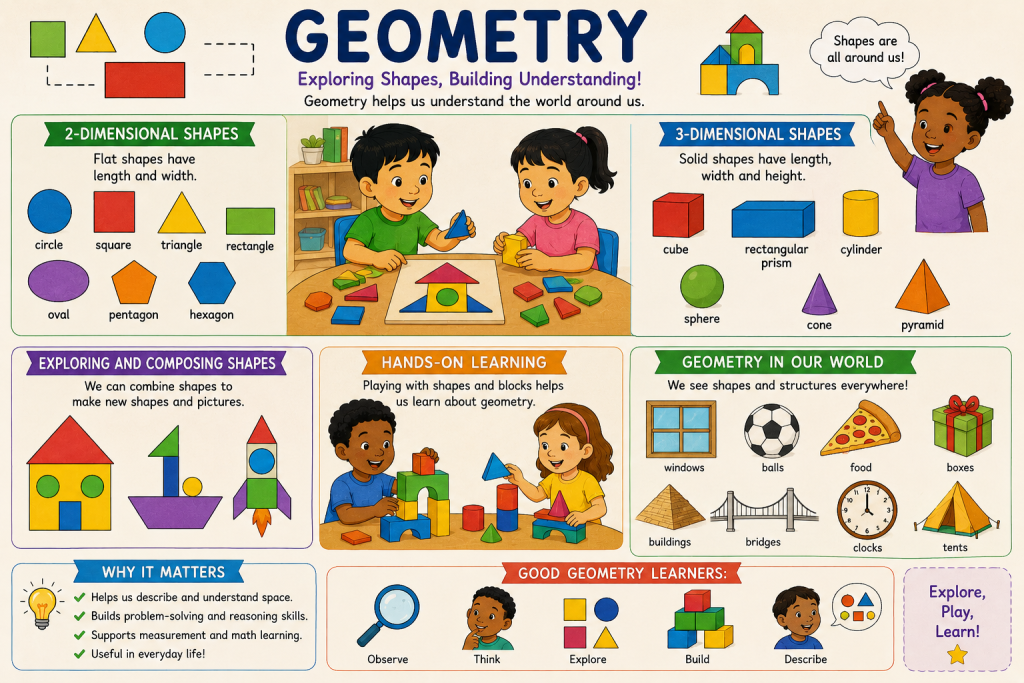
Teaching geometry involves supporting learners in identifying and describing geometric shapes appropriate to their developmental level and in understanding the composition of two-dimensional and three-dimensional figures (Clements & Sarama, 2021). The development of geometric understanding is best supported through exploration of two-dimensional and three-dimensional materials and through hands-on learning experiences. Shapes, blocks, and other construction materials should be readily available for both free play and guided learning activities (Parviainen et al., 2024).
It is important to recognise that geometric shapes are present throughout children’s everyday environments. Learners can identify two-dimensional and three-dimensional forms in both natural settings, such as plants and stones, and human-made environments, such as traffic signs, buildings, and household objects. Meaningful geometric learning can therefore take place without specialised materials.
Teaching geometry to young children can begin within the classroom environment, where teachers introduce basic shapes such as circles, squares, rectangles, and triangles using concrete materials and visual representations. Learners can be encouraged to identify and handle classroom objects that represent these shapes—for example, a clock as a circle, a book as a rectangle, or a floor tile as a square. Such activities support the development of spatial awareness through direct experience and exploration.
As learners become more confident, learning can be extended beyond the classroom through walks around the school or local community. During these activities, learners can observe and identify geometric shapes in real-life contexts, such as windows (rectangles), roofs (triangles), and wheels (circles). This experiential approach aligns with constructivist principles by enabling learners to connect mathematical concepts to their surroundings.
To strengthen home–school connections, teachers may also encourage learners to identify geometric shapes in their home environments. Learners might draw or list examples such as a plate (circle), a door (rectangle), or a box (cube). Parents and caregivers can support this activity by discussing shapes with their children, thereby reinforcing understanding and engagement. Such experiences help learners recognise mathematics as a natural part of everyday life and support the retention and application of geometric concepts.
Practical activity to teach geometry
Identify activities that enhance learners’ understanding of geometry.
Develop inclusive activities that support geometric learning.
Demonstrate activities that strengthen learners’ understanding of geometric concepts.
Particularly important is providing learners with opportunities to encounter shapes in a variety of orientations. For example, triangles should not be presented only in their most familiar form (🔺), but also in alternative orientations (e.g., 🔻). This supports learners’ ability to mentally rotate objects and understand that a shape remains the same regardless of its position (Clements & Sarama, 2021).
Learners should also be exposed to different examples within the same shape category. For instance, they should encounter equilateral, isosceles, and right-angled triangles in order to develop a broad understanding of the variation that exists within geometric categories. The teacher’s role is to ensure that learners have opportunities to explore a wide range of shapes and forms appropriate to their age and level of spatial understanding. Teachers should also provide intentional guidance that helps learners deepen their understanding of geometric concepts.
Adequate time should be allocated for block play and construction activities, as these experiences support spatial reasoning and the understanding of three-dimensional structures (Verdine et al., 2014). Play and exploration with blocks make learning engaging while also providing opportunities for mathematical discussion and the use of mathematical vocabulary (Clements & Sarama, 2021). Active teacher participation in these discussions is important, as the use of mathematical language during play has been shown to support children’s mathematical and conceptual understanding (Björklund et al., 2018; Brandt, 2013).
To further support geometric learning, learners should be provided with opportunities to compose and decompose both two-dimensional and three-dimensional shapes (Clements & Sarama, 2021). Block play provides valuable opportunities for exploring the composition and decomposition of three-dimensional objects, while tangrams, cardboard shapes, and similar materials support learning about two-dimensional figures.
For example, learners may combine individual shapes to create pictures or larger designs. Such activities help them understand how shapes can be combined and separated, while also demonstrating that each component contributes to the overall structure (Clements & Sarama, 2021). Once again, the teacher’s role is not only to provide appropriate materials for exploration and play, but also to support learning through intentional mathematical interactions that encourage observation, discussion, and reflection.
Fuson, K. C., & Briars, D. J. (1990). Using a base-ten blocks learning/teaching approach for first-and second-grade place-value and multidigit addition and subtraction. Journal for research in mathematics education, 21(3), 180-206.
Koponen, T., Aro, T., & Ahonen, T. (2009). Conceptual knowledge-based strategy training in single-digit calculation: A single case intervention study. European Journal of Special Needs Education, 24, 259-276.
Koponen, T., Sorvo, R., Dowker, A., Räikkönen, E., Viholainen, H., Aro, T., & Aro, M. (2018). Does Multi-Component Strategy Training Improve Calculation Fluency among Poor Performing Elementary School Children? Frontiers in Psychology, section Educational Psychology, 9:1187.
Bowie, L. H., & Graven, M. H. (2024). Using games to develop number sense in early grade maths clubs. South African Journal of Childhood Education, 14(1), a1493.
Hidayah, F. N., & Retnawati, H. (2024). The impact of numeracy on early childhood development: A meta-analysis of experimental studies. Golden Age: Jurnal Ilmiah Tumbuh Kembang Anak Usia Dini, 9(3), 559–573.
Mix, K. S., Yuan, L., & others. (2014). Early understanding of multidigit numbers and place value.
Moeller, K., Pixner, S., Zuber, J., Kaufmann, L., & Nuerk, H.-C. (2011). Early place-value understanding as a predictor of later arithmetic performance. Learning and Instruction, 21(5), 631–641.
Van de Walle, J. A., Karp, K. S., & Bay-Williams, J. M. (2020). Elementary and middle school mathematics: Teaching developmentally (10th ed.). Pearson.
Björklund, C., Magnusson, M., & Palmér, H. (2018). Teachers’ involvement in children’s mathematizing – Beyond dichotomization between play and teaching. European Early Childhood Education Research Journal, 26(4), 469–480. https://doi.org/10.1080/1350293X.2018.1487162
Brandt, B. (2013). Everyday pedagogical practices in mathematical play situations in German “kindergarten”. Educational Studies in Mathematics, 84, 227–248. https://doi.org/10.1007/s10649-013-9490-6
Clements, D. H., & Sarama, J. (2021). Learning and teaching early math: The learning trajectories approach (3rd ed.). Taylor & Francis.
Parviainen, P., Eklund, K., Koivula, M., Liinamaa, T., & Rutanen, N. (2024). Enhancing Teachers’ Pedagogical Awareness of Teaching Early Mathematical Skills: A Mixed Methods Study of Tailored Professional Development Program. Early Education and Development, 35(5), 1103-1125. https://doi.org/10.1080/10409289.2024.2336661
Verdine, B. N., Golinkoff, R. M., Hirsh-Pasek, K., & Newcombe, N. S. (2014). Deconstructing building blocks: Preschoolers’ spatial assembly performance relates to early mathematical skills. Child Development, 85(3), 1062–1076. https://doi.org/10.1111/cdev.12165