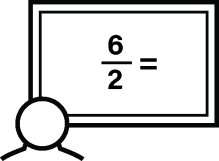
Teaching early maths skills focuses on providing experiences that develop foundational mathematical concepts.
Mathematical skills are best introduced and practised through play and everyday activities using concrete materials (e.g., board games, hands-on experiences, and songs).
Small-group activities allow learners to share strategies, discuss ideas, and learn from one another.
Teachers’ conscious use of mathematical language promotes children’s mathematical learning.
Providing opportunities to explore mathematics in different environments strengthens mathematical learning.
Teaching maths skills in the early years should focus on providing appropriate environments and learning experiences. This involves educators offering opportunities to develop foundational concepts such as number sense, counting, numeral and pattern recognition, comparison of numerical magnitudes, and the manipulation of quantities through simple addition and subtraction (Clements & Sarama, 2014; Gasteiger et al., 2021). These concepts are often best introduced through play and everyday activities. Teachers should use concrete materials, encourage learners to explain their thinking, and provide opportunities for exploration. The aim is to build strong numerical understanding that supports later mathematical reasoning and problem-solving.
Importantly, early mathematics teaching should be embedded within meaningful cultural and everyday contexts. Ethnomathematical approaches, such as the use of traditional games, storytelling, and real-world tasks, help children connect mathematical concepts to familiar experiences and materials available in their local environment. Small-group activities should be used regularly, as they allow learners to share strategies, discuss ideas, and learn from one another, fostering both social and cognitive development (Vogt et al., 2023; Vygotsky, 1978).
Developing number knowledge
Number knowledge involves much more than recognising numerals. Learners need to develop a sense of quantity by understanding which numbers are larger or smaller, making reasonable estimates, and recognising relationships between numbers. Teaching number concepts involves helping learners understand what number words and written number symbols mean and how they relate to one another.
This understanding is best developed through active, hands-on experiences such as counting objects, comparing quantities, grouping items, and identifying patterns. During play, learners naturally compare, sort, add, and take away objects. Teachers can encourage mathematical thinking by asking questions such as: “How many do you see?”, “Which group has more?”, and “Can we make five using these counters?”
The teacher’s role is to guide these experiences thoughtfully so that number concepts develop gradually and meaningfully. Activities and strategies may include:
Interactive games: Games that require counting and number recognition.
Manipulatives: Using number blocks, flashcards, seeds, stones, or sticks to help learners explore numbers through play.
Drawing and colouring: Encouraging learners to connect numbers with drawing and colouring activities to reinforce learning.
Familiar objects: Relating numbers to familiar objects such as food and household items.
The goal is for learners to develop a meaningful understanding of numbers rather than simply memorising number names or symbols.
A major focus of early numeracy development is learning to count. Number words can be introduced through songs and rhymes, helping learners become familiar with number sequences in an engaging and memorable way. Repetition and consistency are important strategies that support memorisation and understanding (National Association for the Education of Young Children [NAEYC], 2020).
Everyday activities, such as counting bottle tops, sticks, fingers and toes, or steps while walking, provide authentic opportunities for children to practise counting. Learners should also be encouraged to count together, as collaborative activities support both social and cognitive development while making learning enjoyable and interactive (Björklund et al., 2022; Vygotsky, 1978).
Meaningful object counting enables learners to practise counting aloud while gradually linking verbal counting to physical objects. It is essential to reinforce one-to-one correspondence, ensuring that each object is counted only once, and to emphasise that the final number in a count represents the total quantity, known as cardinality (Gelman & Gallistel, 1978; Laski & Siegler, 2023). Using familiar materials, such as bottle tops, allows learners to practise counting in playful and meaningful ways. Introducing a variety of objects helps learners understand the abstract nature of numbers rather than associating them exclusively with particular items.
Subitising refers to the ability to recognise the number of objects in a small collection without counting. Teaching subitising involves presenting small collections briefly and encouraging learners to form mental images of quantity patterns. Visual aids such as dot patterns, ten-frames, and everyday materials can support this process.
Importantly, learners should be exposed to both regular and irregular arrangements of objects. This deepens their understanding of quantity and prevents overreliance on memorised visual patterns.
Recognizing number symbols
Recognising number symbols is an important component of early mathematical learning. Activities such as matching objects to numeral flashcards, participating in number-focused songs, and identifying numbers in books and posters support this development (Charlesworth, 2016; Elia et al., 2021). Matching numerals to quantities across a range of contexts helps children develop a flexible understanding of number representation and strengthens the connection between symbols and quantities.
Model activity: Number recognition
Activities involving use of:
Number Flashcards, Number cards, Number charts, Number lines, Number cut-outs
On each of the above, ensure you have a number symbol and number sign on the same card in case of children who need extra support.( esp. HI, Raised for blind, high contrast, bold low vision)]
Introduction
Demonstration/ I Do
Guided Activity/ We do
Practice/ You do
Today we shall say/sign number names for the symbols. I will show/present a number symbol and you say/sign the number name
Listen/watch carefully. I am going to say/sign the number names for the symbols on the number cards (The teacher to show/present number cards with number symbols 1–5 and say/sign the number name for the symbol.)
Let’s say/sign the number names on the (shown) number cards (The teacher shows cards with number symbols 1–5.) (Present tactile cards. )
In pairs, learners say the number names for the symbols on number cards (One learner shows the number card as the other learner says/signs the number name and they alternate.)
Comparing numerical magnitudes
Learners should be provided with opportunities to compare quantities and develop an understanding of numerical magnitude. Activities such as comparing groups of objects and using visual representations, including number lines, can support this development (Mix et al., 2002; Sella et al., 2021). Games that focus on the concepts of more and less make magnitude comparisons concrete and meaningful. Beginning with obvious differences (e.g., comparing 1 object to 10) and gradually progressing to smaller differences helps scaffold children’s learning and strengthen their understanding of quantity relationships.
Manipulating quantities
Learners should also have opportunities to manipulate quantities through hands-on experiences. Providing objects that can be physically added to or removed from a set helps learners develop a concrete understanding of how quantities change (Ramani et al., 2022; Sarama & Clements, 2009). Visual tools, such as dot cards and simple number lines, can further reinforce these concepts. Early measurement activities, such as comparing the length of a table with that of a chair, also introduce learners to quantitative comparison beyond counting.
Understanding number sequences and number functions
Developing an understanding of number sequences is an important aspect of early mathematical learning. Learners should recognise that numbers follow a fixed order; for example, four comes after three and before five (Montague-Smith & Price, 2012).
Teachers should also introduce different functions of numbers. Ordinal numbers describe position or order, and learners should become familiar with terms such as first, second, and third. Nominal numbers, by contrast, function as labels rather than indicators of quantity or order. Examples include house numbers, telephone numbers, and jersey numbers.
Pattern recognition
Pattern recognition is a fundamental component of early mathematical thinking. Learners should be encouraged to observe regularities in their environment, whether through visual patterns such as stripes, dots, geometric shapes, and patterns on fabrics (e.g., chitenge materials), or through rhythmic patterns in songs and rhymes (Papic, Mulligan, & Mitchelmore, 2011; Rittle-Johnson et al., 2020).
Activities such as arranging objects into repeating sequences, extending patterns, and identifying or correcting disruptions in patterns help develop reasoning, prediction, and problem-solving skills. Teachers should use clear and descriptive mathematical language to support children’s understanding of pattern structures and relationships.
Conclusion
Teaching early maths skills requires thoughtful, playful, and structured engagement with counting, numeral recognition, subitising, pattern recognition, magnitude comparison, and quantity manipulation. By creating rich and interactive learning environments, educators can nurture a positive disposition towards mathematics and establish a strong foundation for future learning.
Ethnomathematical approaches can further strengthen early mathematical learning by embedding mathematics within children’s everyday cultural experiences and play activities. Such approaches may be particularly effective in developing number sense during the early childhood education (ECE) years. Teaching should make use of materials that are readily available in learners’ local environments. Traditional games, storytelling, and real-world activities such as farming, trading, and other community practices can provide meaningful contexts for learning mathematical concepts. Through these experiences, children encounter and use numbers naturally during play, whether guided by a teacher or undertaken collaboratively with peers.
References
Clements, D. H., & Sarama, J. (2020, 3rd Edition). Learning and Teaching Early Math. New York: Routledge.
National Council of Teachers of Mathematics. (2000). Principles and Standards for School Mathematics.
Gelman, R., & Gallistel, C. R. (2009, Revised). The Child’s Understanding of Number. Boston: Harvard University Press. MacDonald, A 2018, Mathematics in Early Childhood Education, Oxford University Press, South Melbourne. Montague-Smith, A & Price, AJ 2012, Mathematics in Early Years Education, 3rd edn, Routledge, New York.