This section examines the nature of children’s learning and approaches to supporting learning in early childhood education.
Early childhood pedagogy is grounded in children’s needs and interests, requiring teachers to observe, interpret, and respond sensitively to children’s initiatives.
Pedagogical planning is guided by an understanding of children’s needs, interests, and the holistic nature of learning and development. Learning occurs across daily activities through interactions with other people and the surrounding environment.
Play-based pedagogy supports children’s holistic development and learning by engaging them in a variety of forms of play.
Differentiated teaching is a comprehensive approach that recognises children’s individual differences and adapts teaching to their needs, interests, abilities, and developmental levels.
Introduction
Pedagogically skilled teachers purposefully plan and implement educational activities while taking into account children’s individual emotional, social, and learning needs. Such practice requires sensitivity in everyday interactions and the ability to identify both individual- and group-level needs, strengths, and developmental goals. These factors shape pedagogical decision-making and are reflected in child-centred teaching practices.
In early childhood education, learning is holistic in nature. Children learn across a wide range of situations and activities throughout the day, including those that occur beyond planned instructional experiences. Learning takes place through movement, exploration, social interaction, and a variety of activities that stimulate curiosity and engagement. Above all, play provides a powerful context for learning and development. Consequently, learning through play is a central approach to supporting young children’s learning.
Children’s Needs
Supporting learning in early childhood education and care (ECEC) requires attention to the diverse and interconnected needs that influence children’s holistic development Developing child. Research indicates that unmet emotional needs, such as low self-esteem or a lack of social acceptance, can negatively affect children’s participation and engagement in ECEC programmes. Addressing these needs through supportive pedagogical practices can enhance both participation and learning outcomes (Lilian et al., 2015).
When considering children’s development, it is important to recognise that each child develops at their own pace and that development occurs simultaneously across multiple domains. At the same time, research has identified general developmental patterns and milestones that characterise typical development. Knowledge of both individual developmental trajectories and broader developmental patterns provides an important foundation for pedagogical planning and the implementation of early childhood education.
In addition to individual developmental needs, children have fundamental human needs that can be understood through Maslow’s hierarchy of needs (Maslow, 1987). According to this framework, basic needs must be sufficiently met before higher-order needs can be addressed. Maslow (1987) identified physiological and safety needs as the most fundamental. For young children, physiological needs include adequate nutrition, rest, and healthcare, while safety needs encompass physical protection, emotional security, and freedom from fear and violence. Within ECEC settings, learning and development are difficult to support effectively if these basic needs remain unmet. This highlights the important role of early childhood education in promoting children’s overall well-being as a foundation for learning.
Children’s interests also play a central role in pedagogical planning. Interests provide valuable insights into children’s thinking, emerging competencies, and developmental priorities. Research suggests that children’s interests are closely linked to learning processes (Pakarinen et al., 2012). When learning experiences align with children’s interests, they are more likely to engage actively, remain motivated, and persist when encountering challenges. Such motivation has important long-term implications for later learning, academic achievement, and lifelong engagement with learning (Hutchins & Jirout, 2025).
Consequently, pedagogy that is responsive to children’s needs and interests not only supports learning in the present but also reflects the broader principles of child-centred education. High-quality early childhood pedagogy involves integrating curricular goals into activities that emerge from, or are informed by, children’s observed interests, needs, and developmental trajectories (Ha et al., 2025).
Child‑centred pedagogy in ECEC is an approach that places children’s interests, needs, developmental stage, and agency at the centre of educational decision-making (Epstein, 2014). This aligns with developmentally appropriate practice (DAP; National Association for the Education of Young Children [NAEYC]), constructivist learning theories, and play-based pedagogy. These perspectives share the assumption that young children learn most effectively through active engagement, exploration, social interaction, and the construction of meaning. Consequently, child-centred pedagogy promotes children’s active participation and encourages them to take an active role in their learning.
Child-centred teaching can support learning in several ways:
Guided play, in which teachers intentionally scaffold learning while respecting children’s autonomy and initiatives (Cade, 2023).
Connecting learning goals to children’s interests and play by observing children’s activities and extending their ideas (NAEYC).
Individualised learning, in which activities and experiences are adapted to children’s developmental levels, needs, and interests.
Active learning, recognising that children often learn most effectively through hands-on experiences. Play-based learning (discussed later in this section) is a key strategy in this approach, allowing children to explore and construct knowledge through interactions with the environment and peers.
Respecting children’s ideas and questions, encouraging educators to build on children’s initiatives rather than relying exclusively on predetermined activities or content.
Research indicates that child-centred classrooms provide strong support for children’s learning efforts, social development, and interests (Stipek & Byler, 2005). Studies have also reported positive associations between child-centred practices and children’s motivation (Stipek et al., 1995). Furthermore, parents tend to express greater trust in teachers who employ child-centred practices in their work (Lerkkanen et al., 2013).
Within child-centred pedagogy, educators provide guidance while also creating opportunities for children to exercise autonomy and make choices based on their interests. Appropriate levels of autonomy can strengthen children’s engagement, initiative, and sense of independence. Child-centred educators are responsive to children’s needs and interests and seek to establish relationships characterised by appreciation, respect, and partnership. In this approach, the teacher’s role is not to direct all learning but to support, scaffold, and extend children’s learning through responsive interactions. In practice, this may involve asking open-ended questions, modelling language and problem‑solving strategies, participating in play as a co-learner, and documenting children’s thinking to inform future pedagogical planning.
At the same time, it would be unrealistic to assume that educational practice can or should be entirely child-centred at all times. Teacher-led approaches are also important in many situations. Such approaches typically emphasise planned instruction, progression towards specific learning goals, and the acquisition of skills through structured learning experiences. Teaching often focuses on developing discrete skills in manageable steps, with feedback and recognition provided when predetermined goals are achieved (Schweinhart & Weikart, 1988). This perspective assumes that certain foundational skills should be established before more advanced skills are introduced (Rasku-Puttonen et al., 2011). Teacher-led classrooms may also provide fewer opportunities for social interaction and shared decision-making than child-centred environments.
In practice, most educators combine child-centred and teacher-led approaches in their daily work (Stipek, 2004). Although research has frequently associated child-centred practices with positive outcomes in children’s academic development, behavioural adjustment (Perry et al., 2007), and motivation (e.g., Lerkkanen et al., 2012), both approaches can be valuable depending on the learning context, educational goals, and the needs of individual children. Similarly, opportunities for adult guidance and child choice naturally vary across different activities throughout the day. Effective pedagogy therefore involves maintaining an appropriate balance between structure and autonomy. Achieving this balance requires careful planning, ongoing observation, and sensitivity to the needs and dynamics of the classroom.
A central principle of early childhood education and care (ECEC) is that children learn holistically. Learning occurs across a wide range of everyday situations and activities and is shaped by continuous interaction with people, materials, and environments (Rodiah et al., 2024). Children’s learning is therefore not limited to planned teaching situations but emerges through the interconnected development of knowledge, thinking, skills, actions, bodily experiences, emotions, and language.
Holistic learning occurs through play, movement, exploration, everyday tasks, and creative activities such as music, drama, and visual arts. A key element in these learning experiences is children’s active agency (Astprachon et al., 2025). When children are able to participate actively, make choices, and influence their learning experiences, they tend to become more deeply engaged. Such engagement is an important contributor to learning and development (Shaffar & Wolff, 2024).
The Child at the Centre of Pedagogical Planning
Educators sometimes associate learning primarily with planned, teacher-led instructional activities, such as lessons in mathematics, literacy, or visual arts. Educators’ values and beliefs, but also the surrounding operational culture, may reinforce the view that learning occurs mainly during formal teaching sessions. As a result, educators may overlook the rich learning opportunities embedded in everyday experiences.
From a holistic perspective, however, learning opportunities are present throughout the day. Everyday situations can provide meaningful contexts for practising a wide range of skills, including mathematical thinking, language development, social interaction, and problem-solving. Children’s learning frequently emerges from their observations, questions, and experiences in daily life.
Research suggests that learning is particularly meaningful when it builds on children’s own interests, experiences, and initiatives and is connected to authentic situations (Astprachon et al., 2025; Rodiah et al., 2024). Such experiences provide children with concrete and relevant opportunities to explore new ideas and understand how knowledge can be applied in everyday life. Consequently, learning experiences that are meaningful, practical, and engaging are often especially effective in ECEC settings.
Spontaneous Learning Situations at the Heart of Holistic Learning
The holistic approach to learning provides a rich foundation for developing skills and acquiring knowledge across a variety of contexts (Rodiah et al., 2024). Learning opportunities may arise during planned activities, outdoor play, mealtimes, transitions, or other everyday situations.
Particularly valuable opportunities often emerge during periods that might otherwise be viewed as routine, such as waiting times or transitions between activities. Capitalising on these moments requires educators to observe children carefully and respond to their interests, questions, and initiatives (DAP; NAEYC).
For example, while waiting to go to lunch, children may begin discussing numbers, quantities, or the number of people present in the group. A responsive teacher can transform this spontaneous interest into a meaningful learning opportunity by asking questions such as: How many children are waiting in line?How many children are wearing yellow today? or How many adults are with us? Through such interactions, everyday situations become opportunities to support mathematical thinking, language development, and social participation. This ability to recognise and utilise naturally occurring learning opportunities lies at the heart of holistic pedagogy in ECEC.
Creating Holistic Pedagogical Practices in ECEC—Integrating Technology, Arts, and Creativity
The key elements of holistic learning and pedagogy are a child-centred approach, active agency and connections between different ways of learning. As suggested above, holistic practice can often be spontaneous, simple, and require relatively little preparation. However, holistic teaching also offers excellent opportunities for pedagogical planning, setting learning goals and working towards them over a longer period of time.
One way of implementing holistic pedagogy is through phenomenon-based learning and integrative teaching. Phenomenon-based learning refers to an approach in which a phenomenon observed in the environment is explored and studied (Schaffar & Wolff, 2024). The aim is to investigate the phenomenon by combining different ways of learning, such as visual arts, literature, and technology. In this sense, phenomenon-based learning provides a practical way to implement integrative teaching.
In ECEC, phenomenon-based learning can originate from something as simple as a child’s observation (Fousteri & Foti, 2024; Schaffar & Wolff, 2024). For example, a child may notice a shadow or an unusual movement in the distance and begin wondering aloud what it might be. A skilled teacher recognises such situations as opportunities for learning and begins to explore children’s ideas through questions and discussion. The teacher might suggest that it could have been an animal and encourage the children to think about what animals might live nearby. If the children become interested in the topic, the teacher can begin planning a broader pedagogical project around it. In practice, phenomenon-based learning often takes the form of project work. This is because project work responds particularly well to the principles of holistic learning, phenomenon-based learning, and integrative teaching (Eliza et al., 2025).
Planning an integrated pedagogical project requires creativity and professional competence (Schaffar & Wolff, 2024). One of the most effective ways to plan a new project is to involve children in the process by collecting their ideas, questions, and suggestions. This strengthens both the child-centred approach and children’s agency throughout the project (Ha et al., 2025). The goal is to integrate different areas of learning into a meaningful and creative project that builds on children’s interests (Fousteri & Foti, 2024). Importantly, a project does not need to be fully planned from the outset. In fact, it is often beneficial to adapt and develop plans as the project progresses. This allows teachers to respond to emerging situations and learning needs in appropriate ways.
The following table provides an example of a project structure and the learning opportunities available at different stages. It illustrates how a wide range of skills and areas of knowledge can be connected to a single topic. Not all of these learning opportunities need to be pursued; rather, the table demonstrates what may be supported at different stages of the project. The project presented here is relatively long-term, but it can easily be shortened or expanded by modifying, adding, or omitting stages. In project-based learning, the duration of a project may vary considerably, ranging from a few hours to several months (Frey, 1986, as cited in Fousteri & Foti, 2024). In this example, the topic is animals, and it is explored through the following seven stages (Table 1):
Table 1: Stages of the project, pedagogical activity, and skill areas
Stage of the project
Pedagogical activity
Child’s skills and areas of knowledge that can be supported
1. Getting to know animals
Reading books, going through photos, searching online
Literacy and multiliteracy skills, social skills, environmental knowledge, technology skills
2. Creating a picture of an animal
Sketching, drawing, colouring
Self-expression, imagination, fine motor skills, colours, design skills
3. Creating an animal figure
Moulding with modelling clay, painting
Self-expression, imagination, fine motor skills, colours, textures, shapes, sizes
4. A nature walk
Observing nature and seeking for inspiration, taking photos, collecting suitable materials from nature
Environmental knowledge, sustainable development, gross motor skills, materials and textures, imagination and creativity, technology skills
5. Building nests, burrows, etc. for the animal figures
Building from natural materials
Environmental knowledge, fine motor skills, materials and textures, engineering skills, imagination and creativity
6. Presentation and photoshoot
Presenting their own work, taking photos of their own work
Social skills, technology skills
7. Playing
Creating play and games around the artwork
Imagination, social skills, emotional skills, self-expression, gross motor skills, fine motor skills
Thus, it can be stated that phenomenon-based project learning is an effective way to support a child’s holistic development. Engaging in the different stages of a project enables children to develop skills simultaneously across several areas of learning. Guided by individual developmental needs, the same activity—such as drawing—may foster different skills in different children. In this sense, a single activity may, for example, emphasise the development of fine motor skills or imaginative capacity in some children, while supporting concentration skills in others.
It should be noted that during a project, the teacher can, through guidance and interaction, steer learning in particular directions in response to children’s needs. For example, in the final phase of the project described above, teachers’ guidance plays a significant role in shaping learning. Teachers can support children’s mutual interaction and dialogue, thereby fostering the development of social skills. By observing children’s play and responding to their needs, the teacher can also enrich play and encourage more imaginative and diverse forms of engagement. The higher the quality of the play and the greater the children’s enthusiasm, the more meaningful the learning that takes place within it.
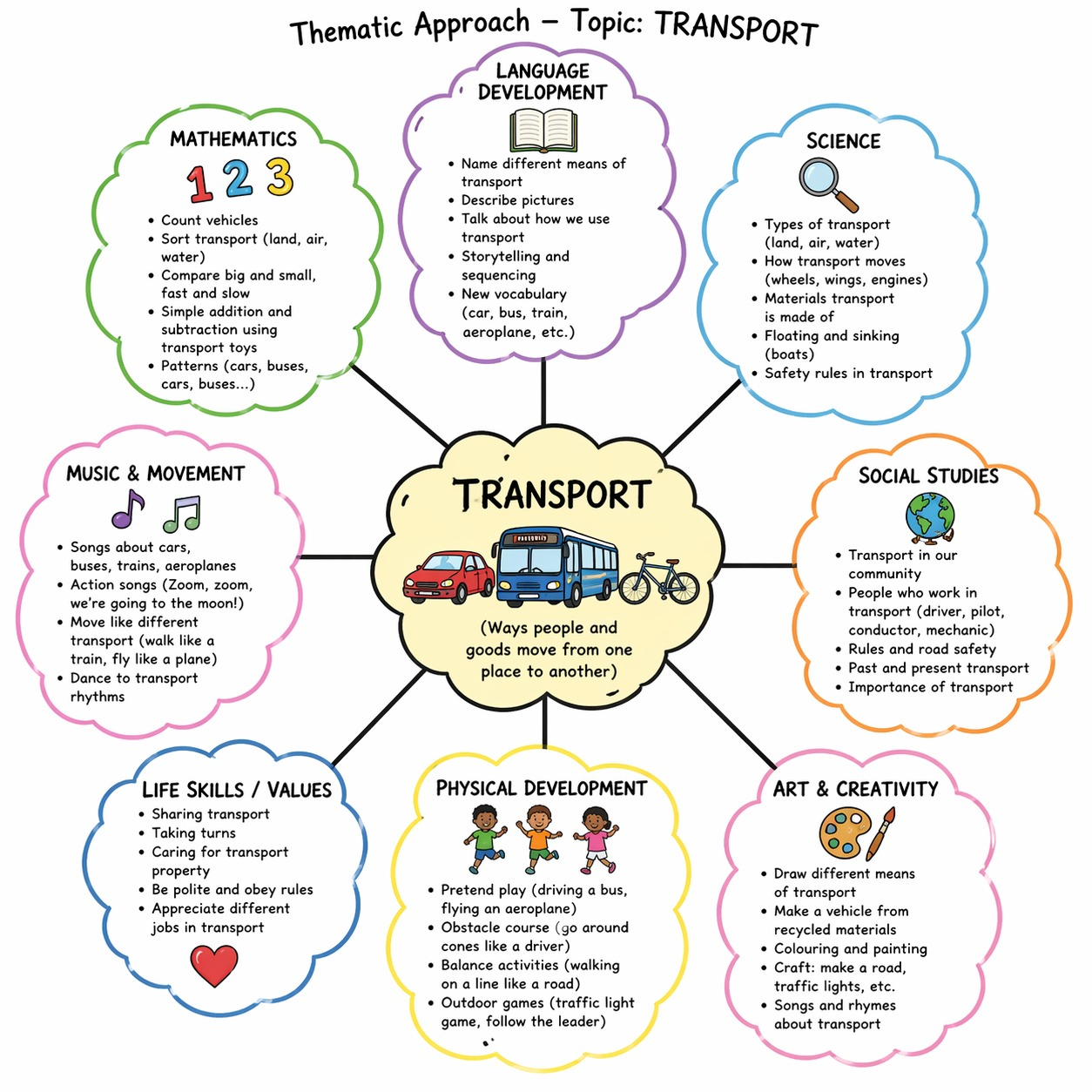
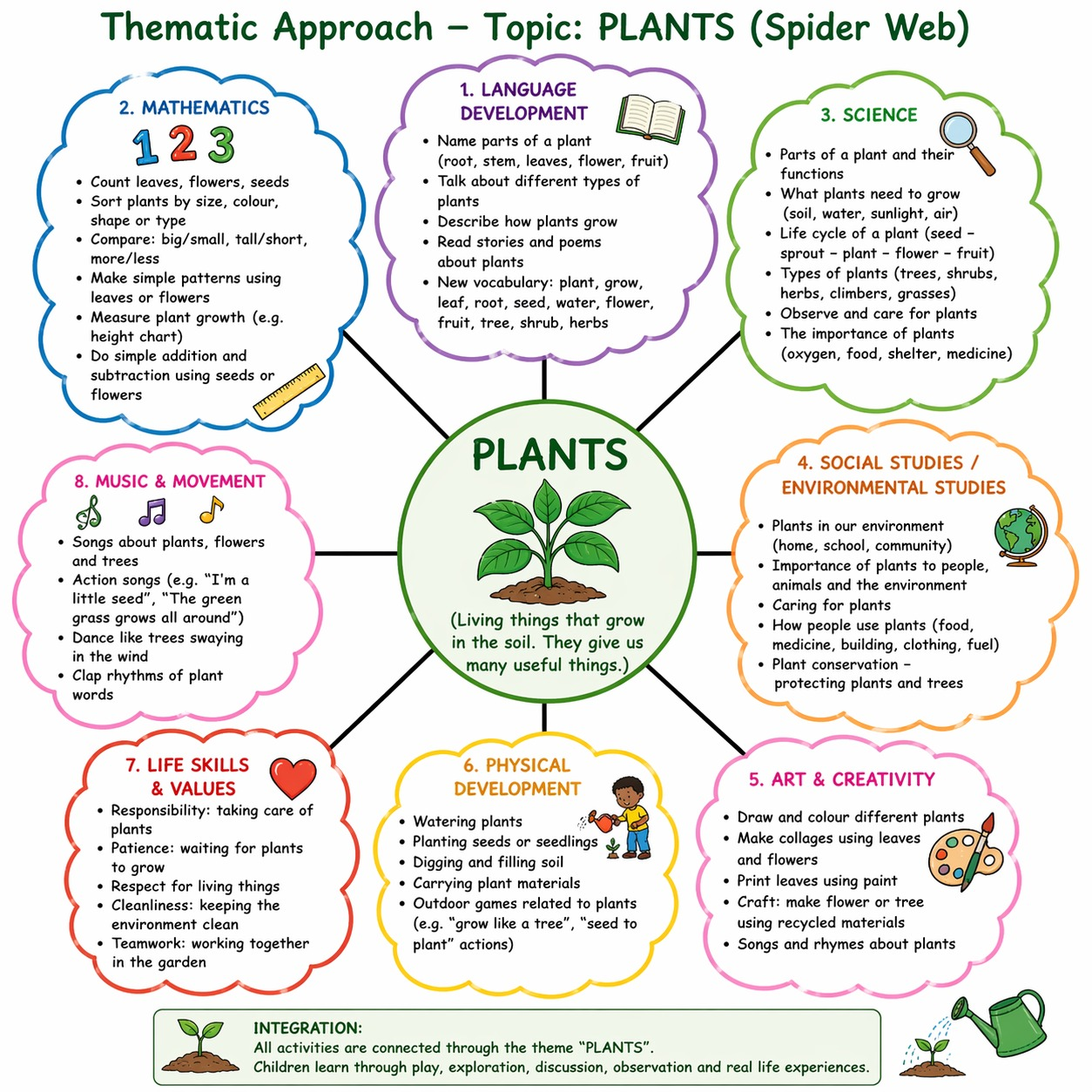
Another prevalent approach to holistic learning and the provision of diverse learning opportunities is the thematic approach. As illustrated in the two examples below (see Figure 1 and 2), the thematic approach entails a central theme that is explored through project work across different curriculum areas. In practice, this means that the same theme is investigated and developed with children through multiple perspectives and activities linked to broader curriculum areas (e.g., music, social studies).
Figure 1: Example 1 of thematic approach: Transport
Figure 2: Example 2 of thematic approach: Plants
Learning Through Play in Play-Based Learning
Play is not merely a form of entertainment for children; it is the primary means through which they engage with and make sense of the world around them (Gordon & Browne, 2017). For young children, play forms a bridge between their inner thoughts, feelings, and the external environment. It is widely recognised as essential for the development of cognitive, social, emotional, and physical skills. Through play, children develop problem-solving abilities, language and communication skills, and social competence. They engage in creative thinking, role play, and relationship-building, all of which contribute to a deeper understanding of both themselves and their environment. Importantly, for young children, learning through play is not incidental but central to their educational experience (Gordon & Browne, 2017).
In African early childhood settings, play is deeply embedded in children’s everyday social and cultural experiences, making it a powerful tool for contextualised learning. Ebrahim et al. (2021) argue that play enables children to draw on their home languages, cultural practices, and community knowledge, thereby strengthening identity formation and supporting meaningful learning. In many African contexts, where resources may be limited, indigenous games, storytelling, and social forms of play serve as important pedagogical tools that foster creativity, collaboration, and problem-solving. This perspective highlights that play-based learning is not only developmentally appropriate but also culturally responsive, supporting inclusive and contextually relevant early childhood education across diverse African settings.
Through play, children can process new ideas, connect experiences, and make sense of their world. It provides opportunities for:
building vocabulary and language skills through interaction with peers and adults;
developing social-emotional skills, including cooperation, sharing, expression of feelings, and conflict resolution; and
supporting cognitive development through engagement in problem-solving, planning, and memory-related activities.
Play-Based Learning
Play-based learning is an educational approach in which children learn through active engagement in various forms of play. It recognises children’s natural curiosity and creativity and emphasises hands-on learning, through which they explore and make sense of the world in meaningful ways (Fleer, 2023; Hirsh-Pasek et al., 2021). Through play, children develop problem-solving abilities, self-regulation, communication skills, and more. Play-based learning helps to establish a strong foundation for lifelong learning and critical thinking (Pyle et al., 2018), offering a developmentally appropriate and engaging approach that supports children in becoming curious, capable, and lifelong learners.
At its core, play-based learning harnesses children’s innate desire to explore, experiment, and create (Edwards, 2022). It promotes active engagement with both the environment and peers while supporting deeper understanding through lived experience rather than rote memorisation or passive learning. Play offers children opportunities to make connections, explore ideas, and build relationships within a safe and supportive context (Fleer & van Oers, 2021). In this way, play-based learning allows children to approach learning in a fun and dynamic way, making it more engaging and enjoyable.
Key Features of Play-Based Learning
Child-Centred: Children’s interests and curiosity drive the learning process.
Hands-on Learning: Activities are interactive and encourage sensory exploration, creativity and problem-solving.
Social Interaction: Children engage with peers, fostering collaboration and communication skills.
Flexible Environment: The learning environment is designed to promote exploration and imagination.
Long-Term Engagement: Children often revisit themes or ideas, deepening their understanding over time.
In their early years, children learn best through activities that allow them to explore, manipulate, and experiment (Nell et al., 2013). Play provides a context in which children acquire new skills, internalise concepts, and build a sense of competence and mastery.
Role of the Teacher in Play-Based Learning
Teachers are regarded as facilitators and guides in play-based learning. According to Bredekamp (2019), teachers are not simply transmitters of knowledge but key contributors to the creation of rich and responsive learning environments. They create spaces that promote exploration, foster curiosity, and support the development of social and emotional skills.
Teachers should observe children carefully to understand their needs, interests, and learning styles. They should provide a safe and stimulating environment enriched with resources that encourage creativity, imagination, and problem-solving. Teachers also scaffold learning by introducing new concepts and ideas during play, helping children extend their thinking and experiences while remaining aligned with curriculum goals. This requires creativity in implementing play-based learning opportunities that allow children to construct understanding through active engagement.
Teachers can enhance the developmental value of play by:
Providing a Balance of Structure and Freedom: A play-based curriculum should offer a balance between structured activities and free play. Structured activities may include planned games or themed activities, but free play allows children the freedom to explore on their own terms.
Encouraging Outdoor Play: Nature-based and outdoor play is vital for the development of motor skills, creativity, and a sense of adventure. Outdoor environments provide children with opportunities for exploration and risk-taking, which are essential for building resilience and confidence.
Promoting Cultural Relevance: Teachers should also be mindful of the cultural backgrounds of the children they work with, ensuring that play-based activities are inclusive and reflect a range of experiences, values, and traditions. This helps children feel seen and valued, promoting a sense of belonging.
Role of the Environment in Play-Based Learning
The learning environment plays a pivotal role in supporting play-based learning (Bredekamp, 2019). The environment is not simply a backdrop for children’s activities but an active component of the learning process. Teachers are encouraged to design environments that include:
rich in materials that support open-ended exploration, such as building blocks, art supplies, natural elements like sand and water, and various sensory experiences;
flexible in its design, allowing children to choose how they engage with the space, which materials they interact with, and how they want to approach tasks or projects; and
safe and inviting, enabling children to express themselves and take appropriate risks in their play. Read more about learning environments here: Learning environments
Benefits of Play-Based Learning
According to Kakembo (2024), there are several benefits of play-based learning for child development. It enhances cognitive development through opportunities for problem-solving, exploration, and discovery. It also supports the development of stronger social skills, as children learn to cooperate, negotiate, and empathise with others. In addition, it contributes to emotional resilience, as children learn to manage challenges and frustrations within play contexts.
Finally, play-based learning promotes readiness for future learning by developing foundational skills needed for formal education. Overall, it fosters a love of learning, supports essential life skills, and builds a strong foundation for future academic and personal success. A play-based curriculum thus positions children not as passive recipients of information but as active, engaged learners exploring and constructing understanding of the world around them.
Differentiated teaching is a comprehensive approach to teaching across broad age ranges, including early childhood education. It refers to planning and implementing teaching in a way that takes into account children’s individual differences, such as needs, interests, and levels of development. In doing so, it ensures that every child is able to participate in education and receive appropriate support for learning (Eikeland & Ohna, 2022; Mavidou & Kakana, 2019; Roiha et al., 2023). This approach is grounded in the inclusive values of early childhood education and the shared understanding that every child is equally valuable. It therefore begins with recognising each child as a capable individual with the potential to learn and develop.
Differentiated teaching is beneficial for every child. Some of the main benefits of differentiation are as follows:
When planning differentiated teaching, it is crucial to understand that it occurs in every aspect of education and can be implemented in both upward and downward directions. This means that there are many practical ways to adjust activities to make them easier or more challenging, depending on the child’s needs.
In this chapter, differentiated teaching practices are introduced based on Roiha et al. (2023) and Roiha and Polso (2021), Five Dimension (5D) model, and their applicability to the ECEC context is examined. According to the 5D model (2023), differentiated teaching practices are divided into the following five categories:
teaching arrangements,
learning environment,
teaching methods,
learning support material, and
assessment of learning.
The planning and implementation of differentiated teaching should proceed from more general actions (teaching arrangements and learning environments) towards more detailed methods (teaching practices and support materials) (Roiha et al., 2023). One of the most important tools for teachers is the assessment of children’s learning. This should guide the teaching process throughout, although assessment of a child’s skills can only be fully understood after all dimensions of differentiation have been considered (Roiha et al., 2023).
Teaching Arrangements
Teaching arrangements (e.g., flexible grouping and co-teaching) are among the first ways learned to differentiate education (Roiha et al., 2023). Flexible grouping allows children to be divided into smaller groups based on criteria such as learning style, social relationships, or interests. Different groupings serve different learning purposes. Co-teaching, in turn, can provide additional professional support and create more opportunities to respond to individual needs within the classroom.
Educators and children engage daily in various interactional situations that differ in size and composition. In African contexts, educator–child interactions typically occur at three levels: individual (dyadic), small group, and whole group. Each level contributes in distinct ways to children’s learning and provides valuable opportunities for growth within the classroom. Similar patterns have been observed across African early learning contexts, where balancing teacher guidance and child agency is central to effective early pedagogy (UNESCO, 2021; Ngwaru & Ngaruiya, 2013).
Activities at the dyadic level
Interaction between an educator and an individual child reflects principles of attachment theory (Bowlby, 1980). At this level, educators demonstrate sensitivity, responsiveness, and reciprocity to address each child’s unique needs and interests. In Namibian ECEC classrooms, one-to-one storytelling, reading corners, and play-based assessments are commonly used to identify individual learning needs and support emotional well-being. These practices foster trust and emotional security, enabling children to engage more confidently in learning. Research shows that warm and responsive educator–child relationships support children’s social competence, peer relationships, and academic outcomes (Downer et al., 2010; Jennings & Greenberg, 2009). Studies in African contexts similarly highlight that culturally responsive one-to-one engagement—such as storytelling in home languages or caregiver-style nurturing—strengthens children’s identities and sense of belonging (Ebrahim, 2010; Marfo et al., 2011).
Small-group activities
Small-group activities enable educators to promote cooperation, communication, and problem-solving skills among children. In Namibian preschools, learning corners or activity stations—such as art, block play, music, and pre-mathematics—encourage teamwork, creativity, and hands-on learning. Educators guide small groups by asking open-ended questions, introducing new vocabulary, and extending learning through inquiry and discussion. For example, during block play, teachers may prompt children to compare sizes, count materials, or discuss balance, thus integrating early numeracy and language development. Small-group formats also enable close observation of social interactions and allow educators to provide targeted support where needed. Research across African ECD programmes suggests that small group activities are particularly effective for inclusive education, peer modelling, and promoting social responsibility within resource-constrained classrooms (Atmore et al., 2012; Murungi, 2018).
Whole-group activities
As in small-group settings, whole-group interaction supports social learning but extends it to a wider network of relationships. At this level, educators can also strengthen children’s sense of belonging and group identity (Hännikäinen & van Oers, 2002; Koivula, 2010). Whole-group instruction teachers should address multiple learners simultaneously.
Whole-group activities, including morning circles, traditional songs, storytelling, and cultural dances, form an essential part of Namibian ECEC practice. These activities promote social cohesion and belonging while connecting learning with the local culture and language. Storytelling sessions often feature indigenous folktales that communicate moral values, support comprehension skills, and strengthen cultural identity. Whole-group learning provides opportunities for children to listen to others, express their ideas, and participate in shared decision-making within a supportive and inclusive environment. In African classrooms, collective learning experiences also reflect Ubuntu philosophy—emphasising interconnectedness, cooperation, and empathy—and support moral development and community values among young learners (Ebrahim & Muthukrishna, 2013; Ngunjiri, 2016).
Learning Environments
Learning environments include all contexts in which teaching and learning take place (Roiha et al., 2023). For this reason, they cannot be understood only as physical spaces but must also be considered from social and psychological perspectives. In this section, learning environments are discussed from a differentiation perspective, while their broader importance is addressed in Section 2.4 Learning environments. Physical, social, and psychological dimensions of learning environments are closely connected to teaching arrangements; teaching and environment are therefore interdependent.
By organising the physical learning environment, teachers can influence, for example, the amount of stimuli, such as noise level and visual stimuli (Roiha et al., 2023). For example, a child who is easily distracted may benefit from working in a quieter area of the classroom. Conversely, children who require closer teacher support may be seated nearer to the teacher, while those who benefit from peer interaction may be seated together. In general, calmer environments support concentration and learning for a wide range of learners (Roiha et al., 2023).
Social and psychological learning environments are often considered together due to their close interconnection (Roiha et al., 2023). The social dimension relates to relationships and interactions, while the psychological dimension concerns emotions and feelings experienced during learning. In early childhood education, a differentiated social and psychological learning environment is based on a safe and positive atmosphere between teachers and children, as well as among peers. This is supported through relationship-building, consistent routines and varied small-group arrangements aligned with learning objectives (Roiha et al., 2023).
Teaching Methods
Teachers’ actions and methods are an important way to make small but effective adjustments that support each child’s learning. A key starting point is the teacher’s speech and instructions (Roiha et al., 2023). Clear language and short, structured instructions are effective tools for differentiation. Teachers may also use agreed listening signals or address individual children by name to attract their attention. Visual supports, such as drawings or picture cards, can further structure instructions step by step.
In addition, time management is crucial for many children (Roiha et al., 2023). Differentiating the duration of activities can support children who struggle with sustained attention while also allowing others to progress at their own pace. Opportunities to use different approaches when learning new content may further increase engagement in learning activities (Roiha et al., 2023). In ECEC, suitable teaching methods include project-based learning and experiential learning, reflecting the holistic nature of children’s learning (see Section 3.4 above).
While flexible methods support individual learning, consistent routines are equally important for predictability (Roiha et al., 2023). The day in early childhood education often begins with familiar routines, such as a morning circle, which helps children settle, supports a sense of safety, and provides an overview of the day. Because young children may not yet understand clock time or abstract instructions, visual schedules and concrete representations of the daily structure are essential. These should be accessible to all children so that they can follow the sequence of activities independently. The day should also end with a familiar routine that signals closure and transition to home (Roiha et al., 2023). Overall, such practices increase predictability, support engagement, and contribute to positive learning experiences.
Learning Support Materials
The use of learning materials and equipment should be considered from the perspective of each child’s needs (Roiha et al., 2023). It is common that the same material is not suitable for all children in the group. Some children require simpler materials to support their learning, while others need more information and details to expand their learning. This is where the differentiation of materials becomes relevant. To support learning, teachers can create new situational and child-specific materials or combine existing materials into suitable sets (Roiha et al., 2023). In addition, it is effective to share appropriate and well-functioning materials among teachers. In this way, pedagogical materials and practices can be extended to the level of the entire ECEC unit. Equipment used to support individual learning typically serves to adapt the learning environment. With different types of equipment, it is possible to reduce noise and other stimuli, reduce stress or anxiety, or make performing certain tasks easier. Examples of early childhood education support materials include:
counting tools (abacus, number lines, counting animals,etc.),
visual timers, visual task lists and cards, first–then cards.
Assessment of Learning
Assessment plays a significant role in teaching and learning (Roiha et al., 2023). For teachers, assessment of learning provides important information about children’s learning and the effectiveness of educational practice. For children, assessment reflects their identity as learners and therefore contributes to shaping that identity. Assessment of learning also produces information beyond the ECEC unit, for example, for families and national and international stakeholders. Due to the far-reaching implications of assessment, it must be directed at the appropriate focus (Roiha et al., 2023).
In early childhood education, assessment is targeted at pedagogy and supporting children’s well-being, rather than at children’s specific skills (Urban et al., 2023). Assessment is supported through observing children’s learning and identifying their strengths, interests, and possible support needs. It is carried out in cooperation between the child, the child’s family, and the professionals working with the children’s group. This supports the participation and involvement of both the child and the family in the educational process. As a result, teachers are able to provide education that responds to individual needs and supports the child’s holistic development.
Examples of Best Practices in Supporting Learning in ECEC
Namibian ECEC classrooms support learning in the following ways:
integrating all three interaction levels by combining structured teacher guidance with child-initiated exploration;
adapting teaching approaches according to developmental stages to promote inclusivity and participation for all learners, including those with diverse needs; and
using locally available materials—such as recycled play items, natural outdoor environments, and family involvement—to enhance children’s learning experiences and support holistic development, as emphasised in Namibia’s Integrated Early Childhood Development (IECD) Policy Framework (Ministry of Gender Equality, Poverty Eradication and Social Welfare, 2018). This aligns with broader African early childhood initiatives that emphasise community participation, culturally grounded pedagogy, and holistic care as foundations for lifelong learning (UNESCO, 2021; African Union, 2016).
African Union. (2016). African Early Childhood Care and Education (ECCE) Framework. African Union Commission.
Astprachon, N., Srikao, S., & Jantharajit, N. (2025). An experiential learning management model (ELMM) for early childhood based on social cognitive theory and constructivist theory. World Journal of Education, 15(1), 67-77.
Atmore, E., van Niekerk, L., & Ashley-Cooper, M. (2012). Challenges facing the early childhood development sector in South Africa. South African Journal of Childhood Education, 2(1), 120–139.
Bowlby, J. (1980). Attachment and loss: Vol. 3. Loss, sadness and depression. Basic Books.
Bredekamp, S. (2020). Effective practice in early childhood education: Building a foundation. Pearson.
Cade, J. (2023). Child-centered pedagogy: Guided play-based learning for preschool children with special needs. Cogent Education, 10(2), 2276476,
Downer, J. T., Sabol, T. J., & Hamre, B. K. (2010). Teacher–child interactions in the classroom: Toward a theory of within‐and cross‐domain links to children’s developmental outcomes. Early Education and Development, 21(5), 699–723.
Ebrahim, H. B. (2010). Tracing historical shifts in early care and education in South Africa. Journal of Education, 48, 1–16.
Ebrahim, H. B., Martin, C., & Excell, L. (2021). Early childhood teachers’ and managers’ lived experiences of the COVID-19 pandemic in South Africa. Journal of Education, (84), 1–20. https://doi.org/10.17159/2520-9868/i84a11
Ebrahim, H. B., & Muthukrishna, N. (2013). Teachers’ agency in early childhood education: A South African perspective. Journal of Education, 57, 1–19.
Edwards, S. (2022). Play-based learning in early childhood education: Pedagogies for 21st century learner. Routledge.
Eikeland, I., & Ohna, S. E. (2022). Differentiation in education: a configurative review. Nordic Journal of Studies in Education Policy, 3, 157-170.
Eliza, D., Mulyeni, T., Yulsyofriend, Mahyuddin, N., Erita, Y., & Dhanil, M. (2025). Implementation of project-based learning in improving scientific literacy in early childhood education: Systematic literature review. Journal of Baltic Science Education, 24(1), 71-91.
Epstein, A. S. (2014). The intentional teacher: Choosing the best strategies for young children’s learning (rev.ed.). Washington, DC: NAEYC.
Fleer, M. (2023). Play in the early years: The cultural-historical foundation of play based learning. Cambridge Press.
Fleer, M., & van Oers, B. (2021). International handbook of early childhood and play. Springer.
Fousteri, M., & Foti, P. (2024). A creative approach of the differentiated teaching and project method in early childhood education.European Journal of Education and Pedagogy, 2, 64–73.
Gordon, A. M., & Browne, K. W. (2017). BEGINNING & BEYOND: Foundations in early childhood education (10th ed.). Cengage.
Ha, T., Lien, V., & Hang, T. (2025). Early childhood education through a child-centered approach: Theoretical foundations and key issues. Macrolinguistics and Microlinguistics, 6, 74-84.
Hirsh-Pasek, K., Golinkoff, R.M., Berk, L.E., & Singer, D. (2020). A mandate for playful learning in preschool: Presenting the evidence. Oxford University Press.
Hutchins, N., & Jirout, J. (2025). Understanding motivation in early childhood: disentangling the links among curiosity, mindset, and goals. Behavioral Sciences, 16(1), 54.
Hännikäinen, M., & van Oers, B. (2002). Togetherness as a quality of the learning context. In M. K. Lohmander (Ed.), Social competence and communication. Researching early childhood 4 (pp. 83–96). Göteborg University, Early Childhood Research and Development Centre.
Jennings, P. A., & Greenberg, M. T. (2009). The prosocial classroom: Teacher social and emotional competence in relation to student and classroom outcomes. Review of Educational Research, 79(1), 491–525.
Kakembo A.A. (2024). The Role of Play in Early Childhood Education: Balancing Fun and Learning. Eurasian Experiment Journal of Arts and Management, 5(3),31-34
Koivula, M. (2010). Children’s sense of community and collaborative learning in a day care center [Doctoral Dissertation, University of Jyväskylä]. Jyväskylä Studies in Education, Psychology and Social Research, 390.
Lerkkanen, M.-K., Kiuru, N., Pakarinen, E., Viljaranta, J., Poikkeus, A.-M., Rasku-Puttonen, H., . . . & Nurmi, J.-E. (2012). The role of teaching practices in the development of children’s interest in reading and mathemathics in kindergarten. Contemporary Educational Psychology, 37, 266–279. doi:10.1016/j.cedpsych.2011.03.004
Lilian, G. K., Odundo, P. A., & Ngaruiya, B. (2015). Effects of Emotional Needs on Participation of Children Aged 4-6 with Learning Disabilities in Early Childhood Centers in Starehe Division, Nairobi County, Kenya. World Journal of Education, 5(3), 79–90.
Marfo, K., Pence, A., LeVine, R., & Harkness, S. (2011). Strengthening Africa’s contributions to child development research and global child development knowledge. Child Development Perspectives, 5(2), 138–143.
Maslow, A. (1987). Motivation and personality (3rd ed). Harper and Row.
Mavidou, A., & Kakana, D. (2019). Differentiated Instruction in Practice: Curriculum Adjustments in Kindergarten. Creative Education, 10, 535-554.
Ministry of Gender Equality, Poverty Eradication and Social Welfare. (2018). Integrated Early Childhood Development Policy Framework. Government of the Republic of Namibia.
Murungi, C. G. (2018). Early childhood education in Kenya: Issues and challenges. African Journal of Education and Practice, 3(1), 1–7.
National Association for the Education of Young Children (July 1, 2026). DAP: Defining Developmentally Appropriate Practice. https://www.naeyc.org/resources/position-statements/dap/definition
Nell, M. L., Drew, W. F., & Bush, D. E. (2013). From play to practice; Connecting teachers’ play to children’s learning. NAEYC.
Ngwaru, J. M., & Ngaruiya, B. N. (2013). Quality ECCE for sustainability: Reflections from East Africa. Childhood Education, 89(3), 183–188.
Ngunjiri, F. W. (2016). Ubuntu, storytelling, and reflection: African ideas for global education. International Review of Education, 62(1), 45–59.
Pakarinen, E., Lerkkanen, M-K. & Poikkeus, A-M. (2012). Ohjausvuorovaikutuksen laadun yhteys lasten taitojen ja motivaation kehitykseen esiopetuksessa. NMI-bulletin, 22.
Perry, K. E., Donohue, K. M., & Weinstein, R. S. (2007). Teaching practices and the promotion of achievement and adjustment in first grade. Journal of School Psychology, 45, 269–292. https://doi.org/10.1016/j.jsp.2007.02.005
Pyle, A., Deluca, C. J., & Daniels, E. (2018). A scoping review of play-based learning: Supporting contexts, pedagogies, and learning outcomes. Early Childhood Education Journal, 46(5), 439–454.
Rasku-Puttonen, H., Pakarinen, E., Trossman, K., Lerkkanen, M.-K., Kikas, E., & Poikkeus, A.-M. (2011). Classroom practices in Finnish and Estonian preschools: Subgroups of observed teaching practices. In M. Veisson, E. Hujala, P. K. Smith, M. Waniganayake, & E. Kikas (Eds.), Global perspectives in early childhood education: Diversity, challenges and possibilities (pp. 313–331). Baltische Studien zur Erziehungs- und Sozialwissenschaft 20. Peter Lang.
Rodiah, I., Zulaika, G., & Saputra, D. (2024). The importance of holistic education for early childhood: integrating cognitive, emotional and social aspects. Journal of Gemilang, 1, 1–8.
Roiha, A., & Polso, J. (2021). The 5-dimensional model: A tangible framework for differentiation. Practical Assessment, Research & Evaluation, 26, 20.
Roiha, A., Polso, J., Mujiono, T., Sanino, D., & Paajanen, M. (2023). Onnistu eriyttämisessä: Toimivan opetuksen opas [Succeed in differentiation: Guidebook of successful teaching] (2nd revised ed.). PS-kustannus.
Schaffar, B., & Wolff, L. A. (2024). Phenomenon-based learning in Finland: a critical overview of its historical and philosophical roots . Cogent Education, 11(1).
Schweinhart, L. J., & Weikart, D. P. (1988). Education for young children living in poverty: Child-initiated learning or teacher-directed instruction?. The Elementary School Journal, 89(2), 213–225.
Stipek, D. J., & Byler, P. (2004). The early childhood classroom observation measure. Early Childhood Research Quarterly, 19, 375–397. https://doi.org/10.1016/j.ecresq.2004.07.007
Stipek, D. J., & Byler, P. (2005). The early childhood classroom observation measure. Coding manual.
Stipek, D., Feiler, R., Daniels, D., & Milburn, S. (1995). Effects of different instructional approaches on young children’s achievement and motivation. Child Development, 66, 209–223. https://doi.org/10.1111/j.1467-8624.1995.tb00866.x
UNESCO. (2021). Early childhood care and education in Africa: Progress and challenges. UNESCO Institute for Statistics.