In this section, we highlight the key principles that are particularly important when considering the potential of inclusive early childhood education to support children who need additional support in their development.
Early identification in ECEC centres focuses on recognising developmental, behavioural, emotional, or learning needs as early as possible so that children can receive timely and appropriate support.
From birth to around five years of age, children’s brains are rapidly developing. Early support can strengthen neural pathways related to language, movement, social skills, and thinking—making support and interventions more effective than if they are introduced later.
Principles of inclusive early childhood education are strongly guided by broader values of equity, access for all, and appreciation of diversity.
In ECEC, the principles of participation and belonging are particularly important and support children’s inclusion more broadly.
At the core of inclusive ECEC are the pedagogies and practices implemented in daily life, including child-centred education, positive learning environments, appropriate teaching strategies, flexible curricula, and collaboration with families.
What Is Inclusive Early Childhood Education?
In this section, we highlight key principles that are particularly important when considering the opportunities that ECEC centres provide to support children who need additional support in their development. It has long been recognised that children, particularly those with disabilities and those who are vulnerable to exclusion, should have their needs identified and addressed as early as possible (European Agency for Special Needs and Inclusive Education [EASIE], 2017, p. 24). However, merely identifying developmental needs is not sufficient. Children’s participation in ECE activities, social interaction with adults and peers, and opportunities for independence and self-initiated activity should be given equal consideration (EASIE, 2017).
In practice, one of the most effective ways to achieve this is through inclusive early childhood education. Although there is no universally accepted definition of inclusion (e.g., Booth et al., 2006), common characteristics identified across the literature include commitments to equality, equity, appreciation of diversity, and non-discrimination (e.g., Ainscow et al., 2006; Dickins, 2014).
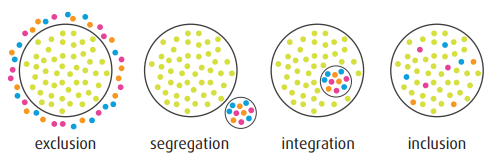
It is important to distinguish between integration and inclusion. As illustrated in Figure 1. (Inclusive Education Summit, 2017, p. 3), integration refers to a situation in which a child who requires additional support is placed in a group of children. Although the child may appear to be integrated into the group, they may nevertheless experience being separated at the physical, functional, or social level because of their support needs. Inclusion, by contrast,involves an approach in which children who require additional support receive the support they need, at an appropriate level or intensity, within their own group alongside their peers. In this sense, inclusion in ECEC aims to ensure that every child receives the support they need without emphasising individual differences in support needs.
As stated by the Inclusive Education Summit (2017, p. 3), “inclusion is not just about kids with disabilities, but rather about the whole stream of child diversity.” From the perspective of everyday ECEC practices, inclusion extends to all children in ECEC and encompasses children’s sense of belonging and participation, the use of child-centred practices, positive learning environments, and collaboration with families.
Figure 1: From exclusion to inclusion
Early Identification and Support
Each child’s needs guide the implementation of inclusive ECEC. Therefore, teachers need to be equipped with the skills required to identify these needs early in childhood.
Early Identification
Early identification in ECEC centres focuses on recognising developmental, behavioural, emotional, or learning needs as early as possible so that children receive timely and appropriate support. The early years are a critical period for brain development. From birth to around five years of age, children’s brains develop rapidly. Early support can strengthen neural pathways related to language, movement, social skills, and thinking—making support and interventions more effective than if they are introduced later (Kolb et al., 2017; Sadoo et al., 2022).
Early identification of additional support is important because it:
supports optimal child development and wellbeing,
prevents minor concerns from becoming long-term challenges,
promotes inclusion and equal learning opportunities,
strengthens school readiness, and
reduces stress for children and families through timely support.
Educators are often the first to notice developmental concerns because of their daily interactions with children. In some cases, parents may be reluctant to disclose concerns about their child’s development due to fear, overprotection, or negative societal attitudes. Therefore, educators’ responsibilities include:
observing children’s play, behaviour, communication, and social interactions,
documenting observations objectively and consistently,
using developmental frameworks to guide assessment and support,
creating inclusive learning environments,
communicating sensitively with families, and
seeking support from, and consulting with, multidisciplinary teams.
Developmental concerns that are commonly identified in a timely manner by teachers in ECEC centres include:
ECEC educators often identify developmental differences at an early stage or receive information about them from families. Early support helps children develop key skills, such as communication, emotional regulation, motor abilities, and social interaction. These foundations are essential for later learning and independence. When support is provided early, children are more likely to make meaningful progress and may require less intensive intervention later in life. With appropriate support, children with developmental challenges can participate fully in everyday activities alongside their peers. This can enhance confidence, self-esteem, and a sense of belonging, while also fostering empathy and understanding among other children. Research indicates that early intervention can significantly improve long-term developmental outcomes. Children who receive early support are also better prepared for the transition to formal schooling and are more likely to adapt successfully to routines, learning expectations, and social environments. Therefore, early support can reduce or mitigate the longer-term impact of developmental difficulties and disabilities (Kumar et al., 2022; Olusanya et al., 2024; von Suchodoletz et al., 2023).
Examples of support strategies in ECEC settings include:
individualised learning plans and adjustments,
targeted small-group or one-to-one activities,
teaching aids and materials that combine visual and auditory supports, including pictures, videos, and sound, together with predictable routines and structured environments,
social-emotional learning strategies,
collaboration with families, specialists, and support services,
referral to early intervention or allied health professionals when needed,
peer-to-peer support,
guidance and counselling, and
gradual release of responsibility.
When developmental delays or special education needs are identified early, support such as speech therapy, adapted activities, or additional guidance can be provided as soon as possible (Liu et al., 2025).
Principles of inclusive early childhood education are strongly guided by broader values of equity, access to all, and appreciation of diversity(e.g., Ainscow et al., 2006; Dickins, 2014). Equity and access in ECEC involve providing adapted resources, representation, and flexible instruction to ensure that all children, regardless of their background or abilities, can succeed.
Equity in ECEC recognises that children begin their learning journeys from different starting points and may require tailored support to thrive. This includes additional learning support for children with disabilities, language support for multilingual learners, culturally responsive teaching, and targeted interventions for children experiencing poverty or instability. Equity ensures fairness by providing each child with the specific support they need rather than treating all children identically (Hahn et al., 2023). Here are three examples:
A child struggles to hold a pencil correctly because their fine motor skills are still developing. The teacher attaches a triangular pencil grip to support the child’s pencil grasp. Other children may not require this support.
In a class that includes children from different cultural backgrounds, the teacher uses pictures, stories, and learning materials that reflect the cultures represented in the group.
A child has severe dyslexia. Instead of writing answers, the child may draw pictures to demonstrate their understanding and is assessed on the content and detail of the drawings.
Access
Accessfocuses on removing barriers that may prevent children from participating in ECEC, including financial constraints, geographical limitations, physical limitations, attitudes, social and psychological limitations, and scheduling difficulties. Programmes that are affordable, inclusive of all genders, cultures, and family structures, available in underserved areas, and supported by local communities are essential for achieving genuine accessibility (Palik & Østby, 2023). Here are two examples:
The teacher recognises that children within the same classroom may have different learning styles. Teaching methods and learning materials therefore include visuals, audiobooks, digital media, and hands-on activities, like word sorting or matching activities, to promote learning and understanding.
One child in the class uses a wheelchair, while another is easily distracted by environmental stimuli or the actions of other children. The teacher ensures that there is sufficient space for the wheelchair to move freely and fit comfortably under a table or desk. The child who is easily distracted is seated in a location that minimises distractions, and the teacher uses clear and simple learning materials to support engagement and learning.
Together, equity and access are fundamental principles of ECEC. They help ensure that every child has the opportunity to participate in and benefit from learning, regardless of their background, abilities, or circumstances. Inclusive ECEC reflects diverse cultures and identities in the curriculum, uses adapted materials and tools, fosters positive attitudes and high expectations, and encourages collaboration with families and specialists. When children feel that they belong, they are more likely to engage in learning and develop essential social and cognitive skills.
Promoting equity and access in early childhood is not only a matter of fairness; it also has long-term benefits. It can reduce educational and social inequalities, support healthy development and school readiness, uphold children’s rights and dignity, and strengthen communities. In essence, ensuring equity and access in ECEC gives every child—especially those facing barriers—with a genuine opportunity to learn, belong, and succeed from the very start (Keles et al., 2024; Solang et al., 2024).
Respecting Diversity
Respecting diversityin ECEC is more than simply tolerating differences; it involves actively valuing and responding positively to the unique qualities of each child, family, and educator. Children bring a wide range of abilities, experiences, languages, cultures, socioeconomic backgrounds, family structures, and learning styles into the learning environment. By recognising and valuing these differences, educators can create inclusive environments that celebrate diversity and transform it into an opportunity for learning, empathy, and understanding.
In practice, respecting diversity means ensuring that all children feel safe, accepted, and valued. Learning experiences should reflect a variety of cultures, languages, and ways of living, while children are encouraged to develop curiosity, respect, and kindness towards others. Families are recognised as partners in learning, and their beliefs, traditions, and home languages are respected.
For educators, respecting diversity also involves ongoing reflection on personal biases, attitudes, and values, as well as engaging in professional dialogue with colleagues. Such value-based discussions are essential for translating inclusive values into inclusive practice. This includes practicing culturally responsive teaching approaches, modelling respectful behaviour, and ensuring that policies and language practices create a welcoming environment for all.
Inclusive ECEC Practices Support Children’s Learning and Development
At the core of inclusive ECEC are the pedagogy and practices implemented in everyday ECEC settings. Implementing inclusive pedagogy is the responsibility of educators.
Participation and Belonging
Participation and belonging are important principles in ECEC and more broadly support inclusion. Every child, regardless of their ability, culture, or language, should be able to participate in activities and learn together with others. When children feel included, valued, and able to participate, they are happier, more confident, and better prepared to learn and grow, not only academically but also socially and emotionally. Inclusion helps children understand diversity and teaches them to respect others (Ngadni et al., 2023).
Children learn best when they can participate in activities that interest them. Participationis not simply about completing tasks; it means that children can share their ideas, make choices, and contribute to decision-making. For example, children can vote on what game to play, choose topics for a project, or help create classroom rules. When children are actively involved, they develop a sense of responsibility and pride in their learning (Dehaene, 2020).
Belongingmeans feeling safe, accepted, and part of a group. Children who feel that they belong are more confident to express themselves, try new activities, and form friendships. Educators can foster this sense of belonging by creating a welcoming environment, showing care, and respecting each child’s background and personality. For instance, celebrating children’s cultures, achievements, or family traditions helps them feel valued and respected.
Finally, participation and belonging can be promoted by giving children a voice. Children should be encouraged to share their opinions, make choices, and take responsibility. This helps them develop confidence, independence, and agency. For example, involving children in planning activities or deciding on classroom decorations can give them a sense of ownership and pride.
Child-Centred Approach
The child-centred approach is an important philosophy in ECEC that places children at the centre of their learning process. This approach focuses on children’s needs, interests, and abilities rather than following a fixed curriculum. It views children as active learners who learn best through play, exploration, and positive relationships. The main goal of the child-centred approach is to support children’s overall development and wellbeing (Howard et al., 2024) while ensuring that the needs of diverse learners are accommodated within learning processes.
One key feature of the child-centred approach is its focus on the whole child. This means supporting not only children’s thinking and learning, but also their social, emotional, physical, and creative development. Children’s wellbeing, sense of belonging, and emotional security are considered essential foundations for learning. When children feel safe and valued, they are more confident and willing to explore their environment.
Another important characteristic is respect for children’s interests and choices. Educators observe children carefully to understand their interests and use this information to plan learning experiences. This gives children a voice in their learning and helps them feel more motivated and engaged. Learning becomes more meaningful when it is based on children’s interests and curiosity.
The child-centred approach also encourages active learning. Children are not passive learners; instead, they learn by doing. Hands-on experiences, exploration, and interaction with others help children build knowledge and understanding. Educators support this by providing materials and opportunities that encourage curiosity and problem-solving (Dehaene, 2020) and by adapting them to best meet the needs and abilities of diverse learners. Individual learning is also strongly valued within this approach. Each child develops at their own pace and has unique strengths and needs. Educators adapt their teaching to support different abilities, learning styles, and cultural backgrounds. This inclusive practice helps ensure that all children have equal opportunities to learn and succeed.
In practice, child-centred practices are supported through positive relationshipsand through the use of multimodal approachesanduniversal design principlesthat recognise the uniqueness of each learner within a group. Strong, caring relationships between educators and children help build trust and emotional security, as suggested by attachment theory (see Ainsworth, 1969). When children feel supported, they are more confident to try new things and take risks in learning.
For young children in ECEC, play-based learning is central to the child-centred approach. Play allows children to make sense of the world, develop skills, and express ideas. Through play, children learn to solve problems, communicate with others, and develop creativity. Educators support both child-initiated and guided play to extend learning while continuing to respect children’s choices.
Positive Learning Environment
A positive learning environment in ECEC is fundamental to fostering every child’s holistic development, wellbeing, and lifelong love of learning. Such an environment goes beyond physical safety and cleanliness; it encompasses emotional, social, and cognitive support that nurtures children within a warm, engaging, and stimulating atmosphere. In a positive learning environment, children feel secure, respected, and valued. Educators and peers play a critical role in building trusting relationships, showing empathy, and responding to individual needs. When children experience consistent encouragement and positive reinforcement, they develop self-confidence, curiosity, and a willingness to explore. In a positive learning environment, educators and peers not only value the aforementioned practices but also model them in their interactions with children. These emotional foundations are essential for developing social skills, resilience, and a growth mindset, especially for children with special education needs.
The physical space also contributes to a positive environment. Classrooms should be well organised, accessible, and rich in age-appropriate materials that encourage exploration, creativity, and problem-solving. Flexible layouts, learning corners, and open-ended resources allow children to engage in meaningful play, which is a primary vehicle for learning in early childhood. It is important to note that the environment should facilitate similar experiences and possibilities for all children, such as private nooks for play, including children who, due to physical handicaps, may have difficulties accessing such areas.
Taken together, a positive learning environment fosters collaboration and inclusivity. Children learn to interact respectfully, resolve conflicts, appreciate diversity, and gain experiences of acceptance among their peers. Educators’ encouragement of communication and group activities that build social competence, while also recognising and celebrating individual differences, is particularly important for children with special education needs, as many studies have shown that these children are at higher risk of social isolation (e.g., Fyssa et al., 2014; Odom et al., 2006).
Teaching Strategies and Flexible Curricula
Teaching strategies that support inclusivity in ECEC for every child include differentiated instruction, scaffolding, and collaborative learning. Differentiation is a pervasive pedagogical approach that is applicable to all teaching (Tomlinson, 2014) and tailors activities to diverse learning styles and learner needs (see, e.g., Roiha & Polso, 2021), while scaffolding provides appropriate teacher or peer support to help children achieve goals that they cannot yet accomplish independently (cf. zone of proximal development, e.g., Vygotsky, 1978). Collaborative learning fosters social skills, empathy, and communication by encouraging children to interact, share ideas, and work together. In practice, teaching strategies intended to support diverse learners can be implemented via gradual release of responsibilities, pre- and re-teaching, peer-to-peer tutoring, universal design for learning, multimodal and multimedia(audio-visual) approaches, as well assandwich teaching (i.e., altering teaching structure to students’ attention spans), chaining strategies, and diverse learning games.
Curriculum content also steers inclusive pedagogy in ECEC. A flexible curriculumis essential for fostering holistic development in young children. Unlike rigid, prescriptive programmes, a flexible curriculum allows educators to adapt learning experiences to the interests, abilities, and cultural background of each child. This approach recognises that children develop at different rates and that learning is most effective when it is child-centred, responsive, and engaging.
Flexible curricula in ECEC often emphasise play-based and inquiry-based learning. These strategies encourage exploration, creativity, and problem-solving, allowing children to construct knowledge through hands-on experiences. Teachers act as facilitators who engage in activities with children, guiding learning while observing and responding to each child’s unique needs. Play-based and inquiry-based learning are characterised by flexible plans and adaptive goal setting (Kangas et al., 2023), which also extend to learning environments, where educators can modify activities, materials, and routines to support individual strengths and emerging skills. The implementation of a flexible curriculum requires pedagogical knowledge and skills from educators. By responding to the dynamic needs of young children, ECEC programmes can nurture curiosity, independence, and a lifelong love of learning (von Suchodoletz et al., 2023).
Collaboration with Families
Collaboration with families is a fundamental aspect of fostering a child’s holistic development in inclusive ECEC. Families are a child’s first teachers, and their involvement in education and care greatly influences children’s social, emotional, and academic growth (Firat & Bildiren, 2024). Parents’ understanding of their children’s developmental characteristics is highly valuable information and should be taken into account when planning ECEC pedagogy, especially for children with learning disabilities (Firat & Bildiren, 2024).
This is important, but must also consider child-rearing practices and myths and sociocultural issues attached to disabilities, which are significantly different from western perspectives (Super & Harkness, 2002). Thus, barriers highlighted by mainstream inclusive may differ from African beliefs. For example, traditional knowledge about causes of disability may prevent parents from engaging schools for help, let alone, cooperating with specialists. Thus, such collaborations should start with creating awareness regarding causes and interventions.
When educators and families work together, they can create a supportive environment that nurtures learning and wellbeing for every child (Otero-Mayer et al., 2025). Families can, for example, contribute valuable insights into their child’s personality, preferences, and experiences, which help educators tailor learning approaches. When families and educators work together, children also experience consistency, emotional support, and reinforcement of learning, both at home and in the classroom. This partnership therefore also enhances children’s sense of belonging and security. Moreover, collaboration strengthens the sense of community and builds trust between families and institutions. It empowers parents to take an active role in their child’s education and fosters consistency between home and school environments. By working together, both families and educators can support children in reaching their full potential.
Effective collaboration requires open communication, mutual respect, and a shared understanding of the child’s needs. Educators can engage families through regular updates, parent–teacher meetings, and participatory activities, ensuring that parents feel valued and heard.
Ainscow, M., Booth, T., & Dyson, A. (2006). Improving schools, developing inclusion. Routledge.
Ainsworth, M. D. S. (1969). Object relations, dependency, and attachment: A theoretical review of the infant-mother relationship. Child Development, 40, 969–1025. https://doi.org/10.2307/1127008
Booth, T., Ainscow, M., & Kingston, D. (2006). Index for inclusion: Developing play, learning and participation in early years and childcare. Centre for Studies on Inclusive Education (CSIE). The Centre for Studies on Inclusive Education.
Dehaene, S. (2020). How we learn: The new science of education and the brain. Penguin.
Dickins, M. (2014). A-Z of inclusion in early childhood. McGraw-Hill Education.
European Agency for Special Needs and Inclusive Education, EASIE.(2017).
Firat, T., & Bildiren, A. (2024). Developmental characteristics of children with learning disabilities aged 0–6 based on parental observations. Current Psychology, 43(4), 2909–2921.
Fyssa, A., Vlachou, A., & Avramidis, E. (2014). Early childhood teachers’ understanding of inclusive education and associated practices: reflections from Greece. International Journal of Early Years Education, 22(2), 223–237.
Hahn, R. A., & Barnett, W. S. (2023). Early childhood education: Health, equity, and economics. Annual review of public health, 44(1), 75–92.
Howard, S. J., Lewis, K. L., Walter, E., Verenikina, I., & Kervin, L. K. (2024). Measuring the quality of adult–child interactions in the context of ECEC: A systematic review on the relationship with developmental and educational outcomes. Educational Psychology Review, 36(1), 6.
Kangas, J., Lastikka, A. L., & Arvola, O. (2023). Inclusive play: Defining elements of playful teaching and learning in culturally and linguistically diverse ECEC. Education Sciences, 13(9), 956.
Keles, S., Munthe, E., & Ruud, E. (2024). A systematic review of interventions promoting social inclusion of immigrant and ethnic minority preschool children. International Journal of Inclusive Education, 28(6), 924-939.
Kolb, B., Harker, A., & Gibb, R. (2017). Principles of plasticity in the developing brain. Developmental Medicine & Child Neurology, 59(12), 1218-1223.
Kumar, S. V., Narayan, S., Malo, P. K., Bhaskarapillai, B., Thippeswamy, H., Desai, G., & Kishore, M. T. (2022). A systematic review and meta-analysis of early childhood intervention programs for developmental difficulties in low-and-middle-income countries. Asian journal of psychiatry, 70, 103026.
Liu, S., Zhu, M., Yi, C., & Zeng, D. (2025). Early rehabilitation interventions for global developmental delay in children: a narrative review. Frontiers in pediatrics, 13, 1576324.
Ngadni, I., Singh, G. K. S., Ahmad, I. Y. B., & Baharudin, S. N. A. (2023). Challenges faced by teachers in inclusive classrooms in Early Childhood Education (ECE) setting. International Journal of Academic Research in progressive education and development, 12(2), 1635-1649.
Odom, S. L., Zercher, C., Li, S., Marquart, J. M., Sandall, S., & Brown, W. H. (2006). Social acceptance and rejection of preschool children with disabilities: A mixed-method analysis. Journal of Educational Psychology, 98(4), 807.
Olusanya, B. O., Wright, S. M., Smythe, T., Khetani, M. A., Moreno-Angarita, M., Gulati, S., … & Gladstone, M. J. (2024). Early childhood development strategy for the world’s children with disabilities. Frontiers in Public Health, 12, 1390107.
Otero-Mayer, A., González-Benito, A., Gutiérrez-de-Rozas, B., & Expósito-Casas, E. (2025). Family involvement in early childhood education: a systematic review of its measurement. Early Childhood Education Journal, 1–22.
Palik, J., & Østby, G. (2023). Interventions to improve refugee children’s access to education and quality learning: A scoping review of existing impact evaluations. International Review of Education, 69(1), 227–247.
Roiha A., Polso J. (2021) The 5-Dimensional Model: A Finnish Approach to Differentiation. In: Banegas D.L.,Beacon G., Pérez Berbain M. (eds) InternationalPerspectives on Diversity in ELT. International Perspectives on English Language Teaching. Palgrave Macmillan, Cham. 74981-1_12
Sadoo, S., Nalugya, R., Lassman, R., Kohli-Lynch, M., Chariot, G., Davies, H. G., … & Tann, C. J. (2022). Early detection and intervention for young children with early developmental disabilities in Western Uganda: a mixed-methods evaluation. BMC pediatrics, 22(1), 158.
Solang, D. J., Yunus, M., Rukmini, B. S., Kurnia, K., & Umam, K. (2024). The impact of early childhood education on long-term outcomes. The Journal of Academic Science, 1(4), 350-361.
von Suchodoletz, A., Lee, D. S., Henry, J., Tamang, S., Premachandra, B., & Yoshikawa, H. (2023). Correction: Early childhood education and care quality and associations with child outcomes: A meta-analysis. PloS one, 18(10), e0293056.
Super, C. M., & Harkness, S. (2002). Culture structures the environment for development. Human development, 45(4), 270-274.
Tomlinson, C. A. (2014). The differentiated classroom: Responding to the needs of all learners. Ascd.
Vygotsky, L. S. (1978). Mind in society: The development of higher psychological processes. Harvard University Press.